A Note from Tommy
THE LESSON
Boys.
Before you read any of this guide, I want you to understand WHY it exists.
It's not because I love writing rules. I don't. It's because we used to be a hell of a lot faster than we are now. And I reckon we can get back there. And further.
This guide is the baseline. The 247 way of doing a job, written down so it's not stuck in my head anymore.
Your job is to learn it. Run it. Then help me make it better.
That last part matters. This isn't the textbook way of doing things. It's OUR way. The stuff I've learnt the hard way over years of running jobs, making mistakes, getting burnt, and figuring out what actually works.
I'm not trying to spoon-feed you. I'm trying to get you thinking. The boys who do well at 247 are the ones who read this once, take it on board, and then start thinking one or two steps ahead on their own.
If we all do it the 247 way, jobs run smoother, callbacks stop, customers love us, and we all go home on time. That's what I'm chasing.
Read it. Use it. Get better.
Tommy Jackson
Director, Team 247
What's the main reason Tommy wrote this guide?
- A) Because he was told to by a consultant
- B) Because he wants new boys to follow rules
- C) Because we used to be faster and he wants to get back there (and further)
- D) Because the office needs documentation
Reveal answer ↓
Answer: C
This guide isn't about rules for the sake of rules. It's a tool to get the crew back to where we were when output was 10-12.5m per person per day. But also bigger than that. I want to turn you boys into the top 1% of fencers in Australia. Absolute weapons. One day this is going to make you all a shit load of money. Read it like a roadmap, not a rulebook.
Why do YOU think this guide exists? Write one or two sentences in your own words.
Let's Talk Numbers
THE LESSON
This is the truth. No sugar coating.
When me and Te were on the tools with the crew, we hit 10 to 12.5 metres of fence per person, per day. Multiple teams. Same gear. Same fences. Same numbers.
Right now, the crew sits around 7.5 metres per person, per day.
That's 25% slower than what we know is possible.
Across a five-day week, that 25% is roughly a full day's wages for every bloke on the crew. Burnt. For nothing. Means Fridays are almost for free. Not sustainable. We need to adjust to keep everything going. Get back to 10m and the rest opens up. Events. Trips. The fun stuff. All more accessible.
Multiply that across a month. A quarter. A year. It's serious money. Money that should be going into better tools, better utes, better pay for the boys carrying their weight, and less stress on rain days when we're trying to catch up.
I'm not bringing this up to have a go. I'm bringing it up because I know what we're capable of. I've SEEN it.
Getting back to 10m a day isn't about flogging yourselves harder. It's about being smarter. That's what this guide is for.
The new baseline: 10m per person per day.
From today. Non-negotiable.
This isn't a stretch target. It's the floor. The standard. The minimum we're aiming for every single day. We've already done it. We just need to remember how.
Anything less than 10m, we go back to the drawing board and work out what slowed us down. Anything more, we work out what we did differently and lock it in for next time. Some days will be harder than others. Sleepers, gates, raking, retaining. I understand that and we adjust the staff numbers accordingly to help where we can.
What's the Team 247 minimum daily target per person?
- A) 7.5 metres
- B) 10 metres
- C) 12.5 metres
- D) Whatever feels reasonable for the job
Reveal answer ↓
Answer: B
10m per person per day is the floor, not the target. We've done it before. The 7.5m we're sitting at right now is 25% below where we know we can be. 12.5m is great but it's not the baseline. That's what we chase ABOVE 10.
Across a 5-day week, what does the 25% gap (7.5m vs 10m) actually cost the business per crew member?
- A) Nothing significant
- B) Roughly a full day's wages, burnt
- C) About half a day's wages
- D) Only matters on bigger jobs
Reveal answer ↓
Answer: B
Every bloke working at 7.5m instead of 10m is effectively giving us 4 days of output for 5 days of pay. That's a full day of wages we're burning per bloke per week. Across a year, it's serious money the business is leaking.
Looking back at your last week of work, how do you reckon you stacked up against 10m per day? Honest answer. Whether we win or lose, reflection is the bit that makes us get better.
The Musk Method
THE LESSON
There's a bloke called Elon Musk. You've heard of him. Builds rockets. Builds Teslas. Sent a car into space.
He's got a 5-step method he uses on EVERYTHING. Doesn't matter if it's a rocket engine or how we dig a fence post. The method works the same.
He says it so much in meetings the engineers call it 'the algorithm.' Tells his team he repeats it 'to an annoying degree.' That's a bloke worth 400 billion dollars telling his crew the basics, every day, on repeat.
If it's good enough for SpaceX, it's good enough for a Team 247 fence job.
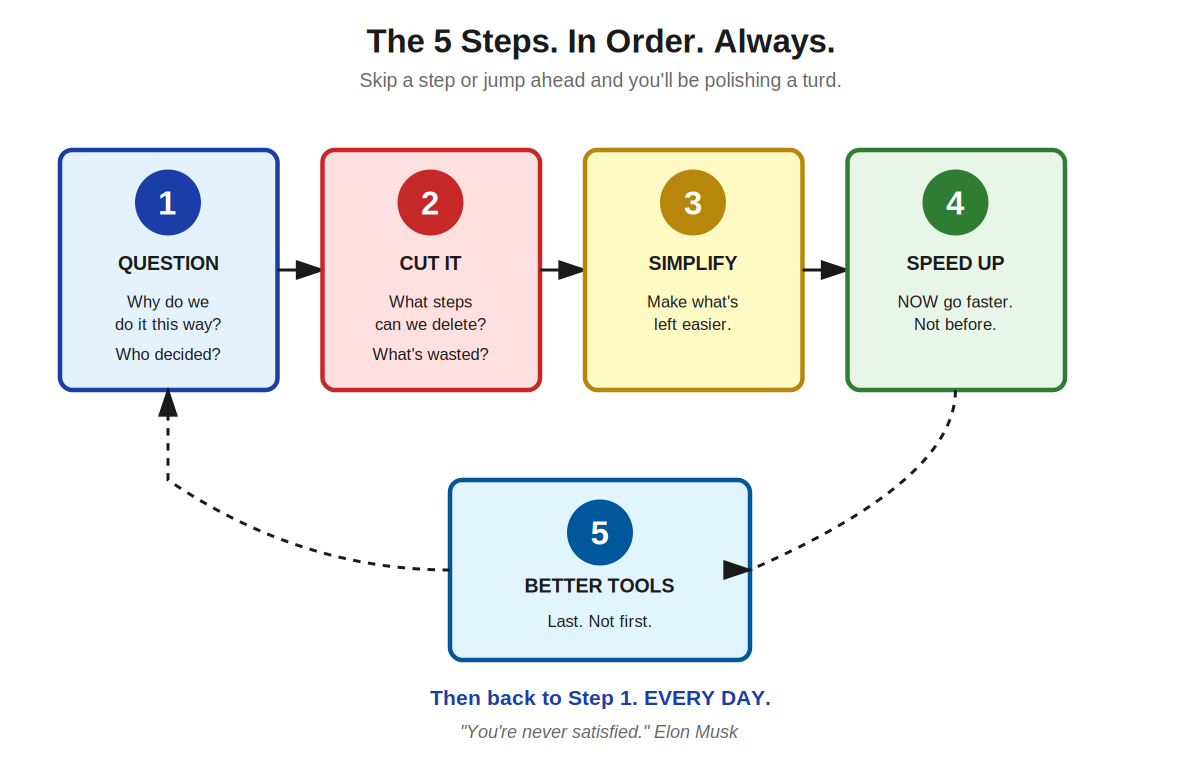
Here are the 5 steps. The order matters. You can't skip ahead. Speeding up a step that shouldn't even exist is a waste of time.
Step 1. QUESTION the way we do it.
Ask yourself: Why do we do it this way? Who decided this was the way? Is it actually right, or just what we've always done? Most stuff we do is right. But some of it is rubbish habits we never questioned. The point is to look.
Step 2. CUT the rubbish.
Look at all the steps. What can we delete? Did we walk to the trailer 14 times? Why? Did we dig a hole, then move dirt twice? Why? Did someone stand around waiting for a tool? Why? If a step doesn't need to be there, kill it. Don't try to make it faster. Delete it.
Step 3. SIMPLIFY what's left.
Of the stuff that has to stay, can we make it easier? Can two trips become one? Can we set the trailer closer? Can we pre-cut sheets so the install is faster? Same job, less effort. That's the win.
Step 4. SPEED IT UP.
ONLY AFTER you've questioned, cut, and simplified. Now you can push the pace. Now you can chase the numbers. Speeding up a bad process is just doing bad work faster. Don't do it.
Step 5. BETTER TOOLS.
LAST step. Not the first. A $2,000 tool won't fix a $200 problem in your process. Sort the process first. THEN look at whether a better tool, a better ute setup, a better trailer config, or a new piece of tech makes us even faster.
This is why I don't just buy every new tool that comes out. We have to earn the right to upgrade by being good at the basics first.
You notice the crew is walking back to the trailer 14 times during a job to grab tools. Which step of the Musk Method are you in?
- A) Step 1. Questioning the process
- B) Step 2. Cutting the rubbish
- C) Step 4. Speeding it up
- D) Step 5. Buying a better tool belt
Reveal answer ↓
Answer: B
Walking 14 times is wasted steps. The job isn't to walk faster (that's Step 4) or buy a tool belt to carry more stuff (that's Step 5). The job is to ask why we're walking 14 times and DELETE most of those trips. Cut the rubbish before you try to speed anything up.
Which step is LAST in the Musk Method?
- A) Question
- B) Cut
- C) Speed it up
- D) Better tools
Reveal answer ↓
Answer: D
A $2,000 tool won't fix a $200 problem in your process. We have to earn the right to upgrade by being good at the basics first. Sort the process, then think about tools.
The Musk Method works for EVERY problem on every job. Big or small. Stuck on a slow demo? Run the 5 steps. Slow set-out? Run the 5 steps. Customer keeps complaining about the same thing? Run the 5 steps.
It's the universal tool for getting better at anything.
Think about the last job you did. What's ONE step in your day that you could DELETE entirely (Step 2. Cut the rubbish)?
The Daily Drill
THE LESSON
The Musk Method is the framework. The Daily Drill is how we APPLY it on a job site without overthinking it.
Every day, before the tools go on the ute, the crew has a quick huddle. Sit, stand, doesn't matter. 5 minutes. Team work, get shit done.
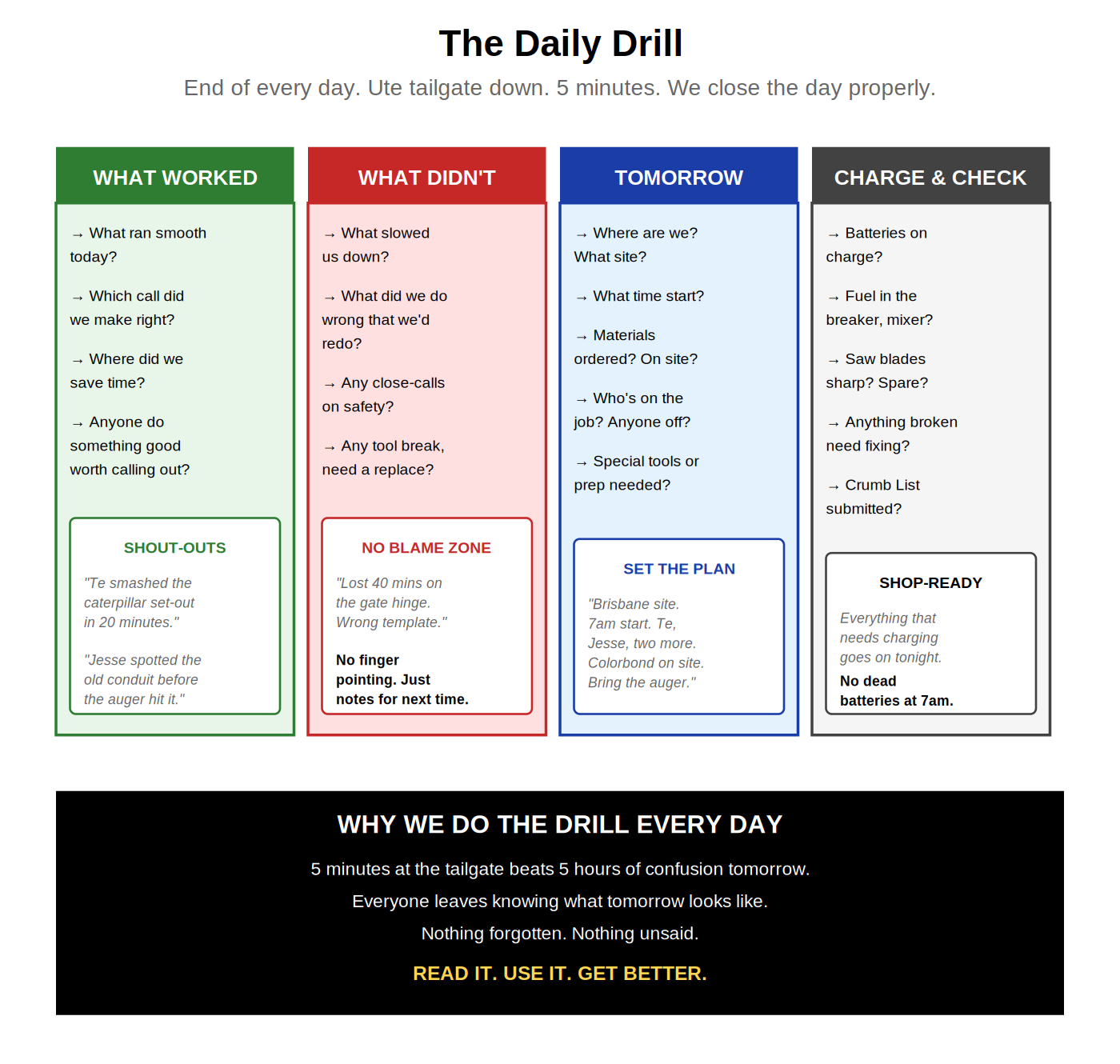
The Drill has 4 parts. We run them in order, every day, no exceptions.
Part 1. WHAT WORKED.
Each bloke says ONE thing that went well today. A trick that saved time. A call that worked. A teammate who smashed it.
Above 10m per person? Good day. Lock in what made it good.
Below 10m? Not a bad day. A day to learn from.
Part 2. WHAT DIDN'T.
Don't blame each other. Blame the system. This is a LEARN AND ADJUST ZONE. If one of us is struggling, the others lift them up. That's how the crew gets stronger.
Ask: Was it the gear? Tools blunt, missing, broken? Was it the plan? Did we set out badly and double up? Was it the access? Trailer too far, lugging stuff? Was it the ground? Rock, roots, services? Was it us? Standing around, waiting, not thinking ahead?
Be honest. The boys who can be honest about a bad day are the boys who improve.
Part 3. TOMORROW.
Lock in one change for tomorrow. Not ten. One.
"Tomorrow we'll set the trailer 5 metres closer."
"Tomorrow we'll pre-cut all the sheets in the morning."
"Tomorrow we'll keep all the spare blades in the demo apron."
Then agree the plan. Where are we? What time start? Who's on the crew? Materials sorted?
One small change a day adds up. Every day for a year is 365 improvements. That's how you go from 7.5 to 10. That's how you go from 10 to 12.5.
Part 4. CHARGE & CHECK.
Batteries on the charger tonight. Fuel topped up. Anything broken called out so it can be replaced before 7am tomorrow.
Dead batteries at 7am cost us 20 minutes of the morning. 5 minutes tonight saves that. Always.
Tomorrow's plan is locked in. How many changes from today should we commit to making?
- A) As many as we can think of
- B) One
- C) The most important three
- D) None. Just do it the same way
Reveal answer ↓
Answer: B
One change. Not ten. Trying to fix everything at once means nothing actually changes. One small improvement, locked in, becomes the new baseline. Then tomorrow you find the next one. 365 changes in a year. That's how the crew gets better.
During "What didn't". The team identifies that we lost 40 minutes today because the wrong gate hinges were on the trailer. Whose fault is it?
- A) Whoever loaded the trailer
- B) Whoever quoted the job
- C) The system that let it happen. Not any one person
- D) Nobody, it's just bad luck
Reveal answer ↓
Answer: C
NO BLAME ZONE. Blame the system, not the bloke. The question isn't "who stuffed up". It's "how did the system let this happen, and what do we change so it doesn't happen again." Finger-pointing kills improvement.
5 minutes at the tailgate beats 5 hours of confusion tomorrow.
Everyone leaves knowing what tomorrow looks like. Nothing forgotten. Nothing unsaid.
A bad day where you LEARN something is not a bad day. A bad day where you shrug and move on is a wasted day. If we get hit by a problem today, that same problem should never hit us the same way again.
Think about a day in the last month that didn't go well. If you'd done the Daily Drill that night, what's ONE thing you would have changed for the next day?
The Promise
THE LESSON
Here's the deal between you and me. The two-way street that makes Team 247 actually work.
You bring:
- Effort. Real effort, not just showing up.
- Honesty. About what went well, what didn't, and what you don't know.
- Thinking. One step ahead, every time.
- Pride in your work. The fence is the proof of who we are.
- Willingness to do the Daily Drill. Even when you're knackered. Even when it's late.
I bring:
- Better tools when we earn them. Not before.
- Better systems. So jobs flow instead of fight us.
- Fair pay. For boys who carry their weight.
- A business that's actually going somewhere. Not just clocking on for someone else's dream.
We both bring:
- The willingness to question, cut, simplify, speed up, and look for better tools. Together. Every day.
That's the deal. That's how Team 247 gets back to where we were, then past it.
If you're in, you're in. If you're not, that's fine too. But be honest with yourself. The boys who win at 247 are the ones who buy into the system, do the Daily Drill, and look for the next small change.
Now you've read the why. Time to learn the how.
One thing to know before your first job: every job ends with the Crumb List, our 14-item finish checklist. No Crumb List submitted = no invoice = no pay. You'll learn it properly in Chapter 4. Just don't let it surprise you.
Next chapter is The Morning. How every day at 247 actually starts.
Read it. Use it. Get better.
Tommy Jackson
Director, Team 247
The deal between Tommy and the crew is a two-way street. Which of these is YOUR side of the deal?
- A) Better tools and fair pay
- B) Effort, honesty, thinking, pride, and doing the Daily Drill
- C) Better systems and a business going somewhere
- D) Just showing up on time
Reveal answer ↓
Answer: B
Tommy brings tools, systems, pay, and a business going somewhere. Also the attitude to push you toward what you didn't know you had in you. Always here to help. To hit your goals, to chase your passions, whatever you're into. You bring effort, honesty, thinking, pride, and willingness to do the Daily Drill. Both sides have to deliver. If one side doesn't show up, the whole thing breaks.
The Promise asks you for 5 things: effort, honesty, thinking, pride, and Daily Drill commitment. Which one comes EASIEST to you, and which one needs the most work? Be honest. Only you'll see this.
📝 Chapter Quiz
Why does the Day Guide exist?
- A) To document rules for compliance reasons
- B) Because Tommy was told to write it by a consultant
- C) Because the crew used to be 25% faster and we want to get back there
- D) To replace on-the-job training
Reveal answer ↓
Correct: C
This guide exists because the crew used to hit 10-12.5m per person per day and now sits at 7.5m. It's a roadmap back to where we were, then past it. Not a rulebook.
What is the Team 247 daily baseline?
- A) 5 metres per person per day
- B) 7.5 metres per person per day
- C) 10 metres per person per day
- D) 12.5 metres per person per day
Reveal answer ↓
Correct: C
10m per person per day is the floor, not the target. We've done it before. Anything less, we go back to the drawing board.
The Musk Method has 5 steps. Which is the FIRST step?
- A) Speed it up
- B) Question the way we do it
- C) Better tools
- D) Cut the rubbish
Reveal answer ↓
Correct: B
Question first. Ask why we do it this way before anything else. Most stuff is right, some of it is rubbish habits. You can't improve what you haven't questioned.
The Musk Method has 5 steps. Which is the LAST step?
- A) Question the way we do it
- B) Cut the rubbish
- C) Simplify what's left
- D) Better tools
Reveal answer ↓
Correct: D
Better tools is LAST. A $2,000 tool won't fix a $200 process problem. We sort the process first, then look at tool upgrades. Earn the right to upgrade by being good at the basics.
The Daily Drill happens when?
- A) First thing in the morning
- B) Once a week on Fridays
- C) At pack-up, every day, at the tailgate
- D) Only when there's been a problem
Reveal answer ↓
Correct: C
Every day. End of day. Tailgate down. 5 minutes. The crew can't get better if we don't close every day properly and plan the next one.
How many changes should the crew commit to in "Tomorrow" (Part 3 of the Drill)?
- A) As many as we can think of
- B) One
- C) Five
- D) None. Just do it the same
Reveal answer ↓
Correct: B
One change. Locked in. Tomorrow it's the new baseline. 365 small changes in a year beats one big overhaul. Trying to change ten things at once means nothing actually changes.
During "What didn't". What's the rule on blame?
- A) Identify whose fault it was
- B) Vote on who was responsible
- C) NO BLAME ZONE. Blame the system, not the bloke
- D) Tommy decides who's at fault
Reveal answer ↓
Correct: C
No blame zone. Blame the system, not the bloke. The question isn't "who stuffed up". It's "how did the system let this happen, and what do we change." Finger-pointing kills improvement.
Tommy's side of The Promise includes better tools, better systems, fair pay, and a business going somewhere. What does YOUR side include?
- A) Just turning up on time
- B) Effort, honesty, thinking, pride in your work, and willingness to do the Daily Drill
- C) Following every rule in the guide exactly
- D) Working extra hours when needed
Reveal answer ↓
Correct: B
Effort, honesty, thinking, pride, and Daily Drill commitment. Both sides have to deliver. If you don't bring your side, the deal's off.
Welcome to Team 247. Now let's learn how every day starts properly.
Read it. Use it. Get better.