Get There Proper
THE LESSON
The first hour decides the whole day.
If you rush the start, you'll pay for it at 3pm. Every time.
Getting there proper means three things. Showing up early. Getting sorted in the ute. Parking right.
Be on site 5 minutes early.
On time is late. 5 to 10 minutes early is the sweet spot. Don't roll up 20 mins early either, that's annoying for the customer.
Those 5 to 10 minutes are for YOU. Get your gear prepped. Plan the day out in your head. Make sure you've got everything you need before you knock. Better to be sorted in the ute than scrambling once the customer's standing there waiting.
Use the 5 minutes to get sorted in the ute.
Lunchbox out. Chargers ready. Tools ready. Coffee in hand. Quick look over the job notes. Eye the fence from inside the ute if you can see it from where you're parked. By the time you knock at the agreed time, you're already ahead.
Greet at the agreed time. Both customers if you can.
Knock at the time we said we'd be there. Best play is to greet BOTH the customer and their partner before tools come out. Or one bloke chats with the customer while the others get into setup. Chargers running. Power sorted. Gates opened. That's the proper way.
The customer who only sees the AFTER (their partner who's been at work) judges us on the chat at the start and the clean-up at the end. The 5-minute door chat sets the tone.
Park the ute and trailer properly.
Don't block the driveway. Don't park on the nature strip if you can avoid it. Cones out if you're on the road.
And here's the trick most blokes miss. Park the trailer where demo's going to land. Not at the front of the house if the fence is out the back. Saves a hundred trips through the side gate carrying old fence panels.
Think about where the work is. Then park accordingly. Five minutes of thinking saves an hour of walking.
If you're picking up materials on the way:
- Bunnings: 6:30am for daily bits, timber fence stuff, timber sleepers, rapid set if Colorbond suppliers don't have it. Pack the ute so what comes off first is at the back. Check stock before you go. Quick text to the boys when you leave in case anything's changed.
- Ourtown / Oxworks: 7am for Colorbond materials
- Tip first? Call ahead. Otherwise they start packing up before you arrive at 7:30-8.
Day-before ordering is done by Tom, Te or Sarah. If something's missed, snag it on your morning run, don't wait until you're on site.
You arrive at site at 6:55am for a 7am start. What's the right move?
- A) Wait in the ute scrolling your phone until exactly 7am
- B) Use the 5 minutes to get sorted: lunchbox, chargers, tools, coffee, eye the job notes. Knock at 7am.
- C) Knock now at 6:55am, customer probably awake
- D) Walk around the customer's property to scope the fence
Reveal answer ↓
Answer: B
Early arrival is for YOU, not the customer. Don't knock early. Don't waste the 5 mins. Get yourself sorted in the ute. Don't walk around their property uninvited, that's weird. By 7am you're ready to greet.
Where should you park the trailer on a backyard fence job?
- A) On the street out front, neat and tidy
- B) In the driveway, blocking it for the day
- C) As close to where demo will land as possible (often round the back or on the nature strip)
- D) Wherever the customer tells you to
Reveal answer ↓
Answer: C
Park the trailer where demo's going to land. Not the front. Not the driveway. As close to the work as you can get it. Saves hundreds of metres of walking with old fence panels over the course of the day.
Think about your last few jobs. Were you 5 minutes early and sorted, or rolling up on the dot still trying to find your coffee? What changes if you commit to the 5-min rule and have everything sorted before the door knock?
The 247 Kickoff (4 Roles)
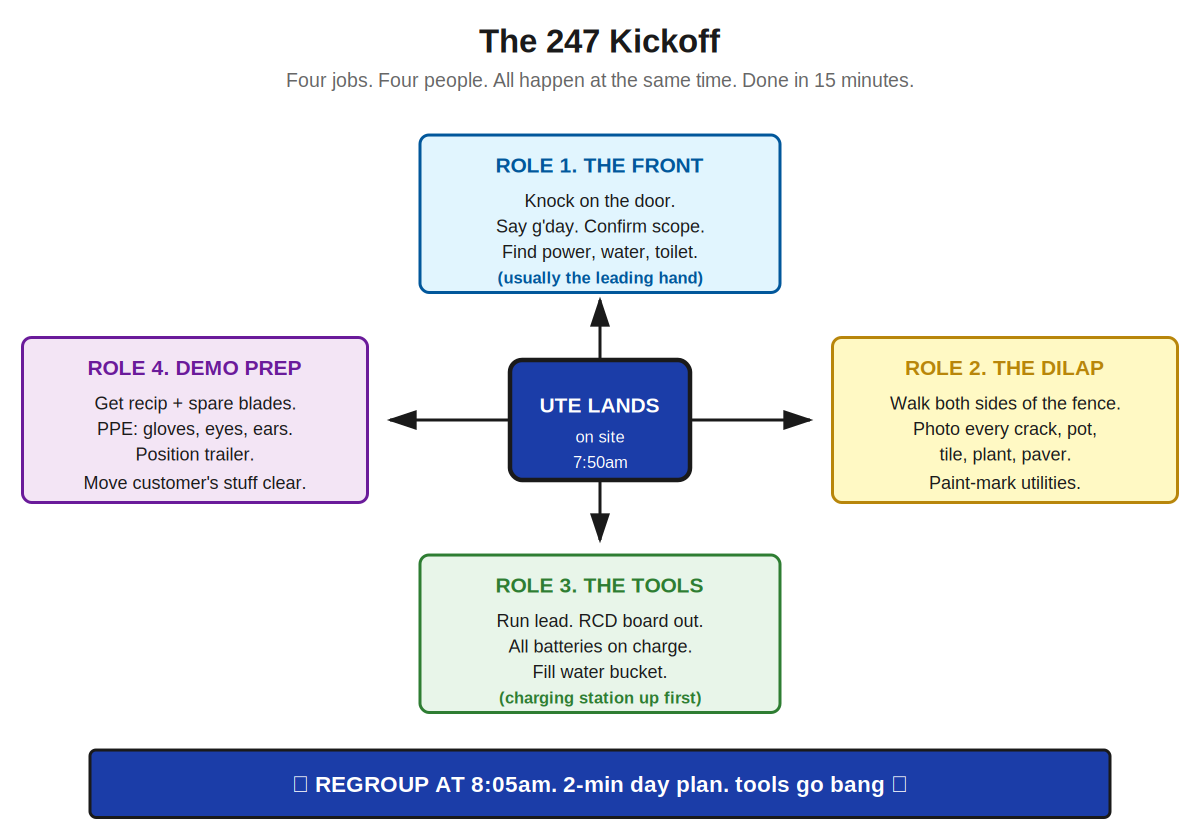
The 247 Kickoff: 4 Roles in Parallel
Video not playing? Watch it on Vimeo →
Watch the crew split into 4 roles. Front bloke greets the customer while the others get straight into setup. By 15 minutes everyone's already moving.
THE LESSON
Soon as we're parked, split the team. Four jobs, four blokes, all at once. This is what makes us faster than every other crew on the street.
The default for most fencing jobs is to spend the first 20 minutes warming up. Look at the fence. Coffee. Chat. Then one bloke gets started while the others catch up. That's fine if you've got all day. We don't.
We don't do that. We split.
Role 1. The Front.
Usually the leading hand. Knocks on the door at the agreed time. Says g'day. Confirms the job. Best play is to greet both the customer AND their partner if they're around. Asks three questions before walking away:
- Where's the power point we can plug into?
- Where's the closest tap?
- Where can the boys use the toilet?
Get these three locked in. Customer rummaging in the kitchen at 11am because someone needs to wee is dead time. Lock the basics in early.
While the Front bloke chats, the other 3 roles are already getting into it. Chargers being set up. Power being run. Gates being opened. Tools coming off the trailer. Nobody's standing around. The chat and the setup happen at the same time.
If the customer says the job's different to the docket. Extra height, different colour, an extra bay they want done. RING ME. Don't say yes on the spot. Don't try to be the hero. Just ring me. I'll deal with it.
Role 2. The Dilap.
One bloke walks both sides of the fence with the phone out. Photos every crack, pot, plant, paver, you name it. This is the most important role of the morning. We'll cover it in full in the next lesson.
Role 3. The Tools.
One bloke sets up the charging station. Runs the lead from the customer's power point. Gets the RCD board out. ALL batteries on charge. Drills, impacts, recips, the lot. Fills the water bucket.
The charging station goes up FIRST. By the time we finish demo, the spares are full and ready to go. No batteries dying at 11am.
Role 4. Demo Prep.
One bloke gets the recip out. Fresh blade. Two or three spares within reach. PPE on. Customer's pot plants, kids' toys, BBQ. All moved clear. Trailer in position.
By the time the other three roles are wrapping up, demo can start without anyone scrambling for gear.
Regroup at the 15-minute mark.
Everyone meets at the start of the fence line. Two-minute day plan (we'll cover that at the end of this chapter). Then tools go bang.
Two-man crew? Same four jobs. One bloke doubles up. Don't skip any of them.
The customer answers the door at the start of Role 1. What are the THREE things you must lock in before walking away?
- A) Their name, the dog's name, and their email
- B) Power point, tap location, toilet location
- C) Their preferred fence colour, gate type, and timeline
- D) Where they want the trailer parked
Reveal answer ↓
Answer: B
Power, tap, toilet. Lock these three in at the start. Otherwise you'll be hunting for a power point at 9am, walking back to the customer's door for water at 11am, and someone will be busting for a wee at 1pm. Three questions. 30 seconds. Saves the whole day.
The customer says they actually want an extra bay of fencing done that wasn't in the quote. What's the right move?
- A) Quote them on the spot and get started
- B) Say no, we can only do what's on the docket
- C) Tell them you can't change anything, sorry
- D) Ring Tommy. Don't agree to anything yet.
Reveal answer ↓
Answer: D
Variations get sorted by Tommy and the office, not by the crew on site. Don't say yes. Don't say no. Ring me. We'll work out scope, price, and timeline together. The bloke on site agreeing to extras leads to disputes about money later.
While other crews are standing around drinking coffee, we've already got four jobs running at once. By the 15-minute mark, the customer knows what's happening, the dilap photos are taken, the batteries are on charge, and demo is ready to start.
That's a 20-minute head start on every other crew. Across a year, that's the difference between a good business and a great one.
The Kickoff splits 4 jobs across 4 blokes. Think about your last job. Were these 4 jobs done in parallel, or one after another? What did that cost the day in time?
The Dilap
THE LESSON
This is probably the most important 10 minutes of our day.
Do it properly and the customer can't come back on us in two weeks claiming we cracked their pavers.
Dilap means a photo and note record of the site BEFORE we touch a thing. It proves what was already cracked, broken, leaning, or knackered when we got there.
If a customer rings up later saying we did something, the photos either back THEM up (we fix it) or back US up (we don't owe them anything). No argument either way. Just facts.
It has saved Team 247 thousands. It will keep saving us. EVERY job. EVERY time.
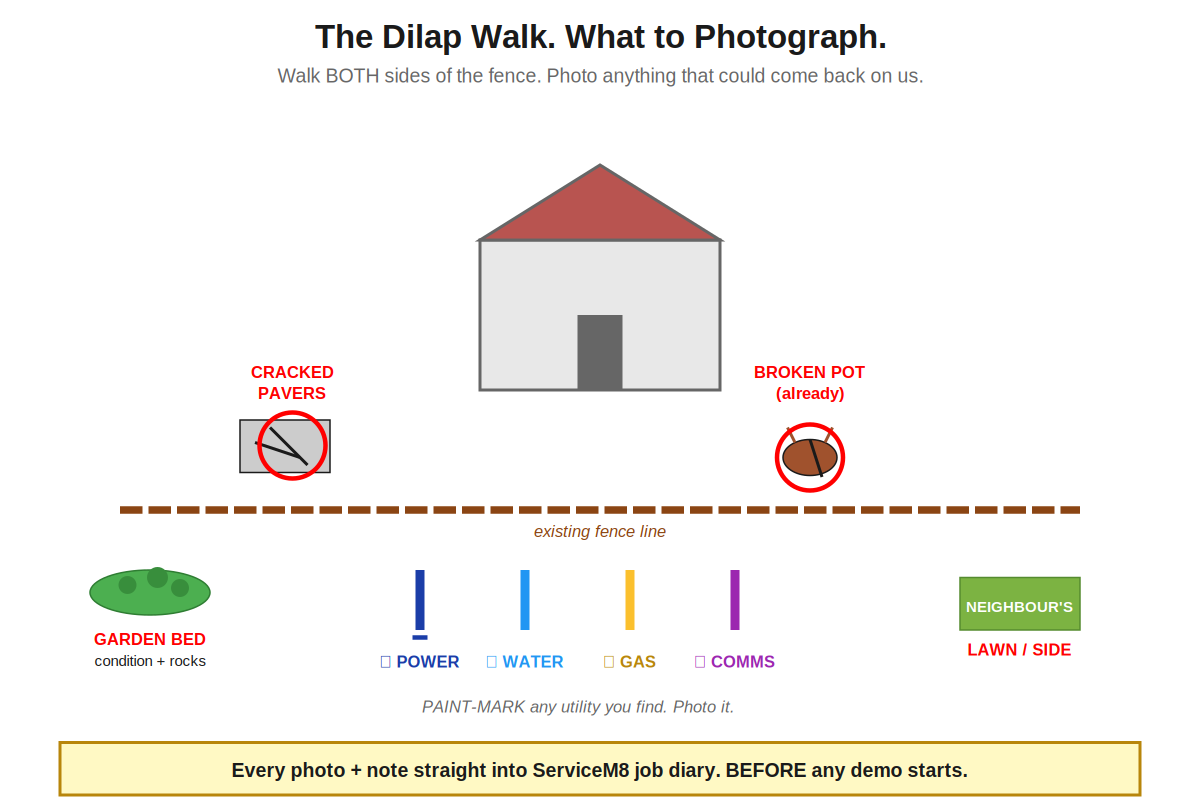
Walk both sides of the fence.
Customer's side AND the neighbour's side. Knock and ask the neighbour first. Don't skip it. Half the disputes come from neighbours who weren't expecting us.
Photo every crack. Every pot. Every plant.
Take heaps. Phones have unlimited photos. Better too many than not enough.
What to photo:
- Cracked pavers, concrete, tiles
- Broken or chipped pots, planters, ornaments
- Garden bed condition. Plants. Rocks. What's actually there.
- Existing fence damage. Leaning posts. Rotten timber. Holes.
- Neighbour's lawn, garden, pavers. Both sides.
- Retaining walls, sleepers, anything we'll work near
- Trees and roots in the post line, especially the neighbour's
- Anything stuck to the fence. Clothes lines, hose reels, lights.
- Customer's outdoor furniture, BBQ, kids' play gear
Wide shot AND close-up of each issue. The wide shows where it is. The close-up shows the damage.
Upload everything into ServiceM8.
Every photo plus a short note. Before any demo starts. Notes like:
- "Cracked paver near south corner. Pre-existing."
- "Broken pot left of gate. Already broken on arrival."
- "Power line marked orange along east boundary."
Time-stamped. Geo-tagged. In the diary. That's our proof.
This is a true story. It saved us a fortune.
We did a strip-out once on a make-safe inside a house. Te was on dilap. While he was photographing the floor protection going down, he accidentally caught a cracked tile in the shot. Already cracked. Before we'd touched a thing.
Couple of weeks later, the customer rang claiming we hadn't put any floor protection down, AND that we'd cracked their tiles. They wanted us to replace tiles through the whole house.
I pulled up Te's photos from ServiceM8. Floor protection clearly down. Cracked tile already there, time-stamped from before we started.
Claim dropped. Saved us a fortune.
We've had it happen on pavers too. Same story. Same outcome.
Ten minutes with a phone has saved this business more money than any tool we own.
How much should you photograph during dilap?
- A) Just the obvious damage so you don't waste time
- B) Take heaps. Phones have unlimited photos. Better too many than not enough.
- C) Only what the customer points out
- D) A general overview shot is enough
Reveal answer ↓
Answer: B
Phones have unlimited photos. There's no cost to over-shooting. There's massive cost to under-shooting. If a customer rings about something we didn't photograph, we're stuck. If we have photos of everything, we've got proof.
You photograph a cracked paver. The customer is right there watching you. What kind of note do you write in ServiceM8?
- A) "Cracked paver"
- B) Nothing. The photo speaks for itself
- C) "Cracked paver near south corner. Pre-existing."
- D) "Customer cracked the paver themselves"
Reveal answer ↓
Answer: C
The note matters as much as the photo. "Pre-existing" is the key word. It locks in the timeline: this was already cracked before we arrived. Time-stamped photo plus a clear note kills disputes before they start.
The Cracked Tile war story shows what 10 minutes of photo work can save. On your next job, what's ONE area you'd normally skip photographing, but should photograph thoroughly?
Utility Marking + DBYD
THE LESSON
Before any post hole gets dug, we need to know what's under the ground. Hitting a power line, water pipe, gas line, or comms cable can kill someone. Or cost us $20,000 in damage. Or both.
DBYD: Dial Before You Dig.
DBYD is Australia's free service that maps underground utilities. Ring 1100 or go to byda.com.au. They send you a plan showing what's under the property. Power, water, gas, sewer, comms, the lot. Free service. Takes 5 working days to come back.
For dig jobs the office runs a DBYD search BEFORE we arrive. The results land in ServiceM8 with the job notes. Front fences are where this really matters. Power, water, comms, gas. They all run out the front. Your job in the morning is to check them and walk the site with the plan in hand.
Paint-mark every utility you find.
Spray on the ground so we can see it. Then photo the marks for the dilap.
The colour code:
- ORANGE for power
- BLUE for water
- YELLOW for gas
- PURPLE or WHITE for comms / NBN
- GREEN for sewer and stormwater
Stick to the colours. Every Aussie tradie uses the same code. If a sparky comes onto site next week and sees orange paint, they know power. If you used red because that was the can you grabbed, they're guessing.
If you hit something you didn't mark. STOP.
Photo it. Ring me. Don't try to fix it. Don't try to hide it. Don't keep digging.
We've had it where a bloke hit a Telstra line and tried to splice it himself. Telstra worked out it was patched, charged us for the repair AND a fine for unauthorised work. Far cheaper to stop, ring me, and get the right tradie out.
What does DBYD stand for?
- A) Don't Break Your Drill
- B) Dial Before You Dig
- C) Daily Before Your Day
- D) Dig Better Your Day
Reveal answer ↓
Answer: B
Dial Before You Dig. Free Australian service that maps underground utilities. Ring 1100 or check byda.com.au. The office runs the search 5 working days before any dig job.
You're digging a post hole and the auger hits something hard at 400mm. It sounds like pipe. What's the right move?
- A) Keep digging carefully to see what it is
- B) Try to dig around it without hitting it again
- C) STOP. Photo it. Ring me.
- D) Cover it back up and pick a new spot
Reveal answer ↓
Answer: C
Stop. Photo. Ring. Don't try to identify it yourself. Don't try to fix it. Don't try to hide it. Even if it turns out to be nothing, the photo proves we did the right thing. If it's a live service, you've avoided a death or a $20,000 bill.
You're marking utilities. The DBYD plan shows a water main running along the east side. What colour paint do you use?
- A) Red
- B) Orange
- C) Blue
- D) Green
Reveal answer ↓
Answer: C
Blue for water. Stick to the Aussie colour code. Orange is power. Yellow is gas. Purple or white is comms. Green is sewer and stormwater. Same code on every site. Don't improvise.
Have you ever been on a job where utilities weren't marked properly? What happened? What would the DBYD + paint marking process have changed?
Charging Station + Setup
THE LESSON
Most of this is handled by Role 3 during the Kickoff. But everyone needs to know how it's done, because everyone will end up doing it at some point.
Run the lead.
Run the lead with common sense.
Power point to the work area. Out of the way of the customer, the boys, and any kids running around.
NOT along the fence line. That's where we're working. Recip blades, grinders, post hole diggers, all live. A lead in the work zone gets sliced. Cut it once, you're chasing power for the rest of the day. Worse, you might get a belt off it. Run the lead AROUND the work, not through it.
Tape it down if it crosses a path. Don't run it across a doorway.
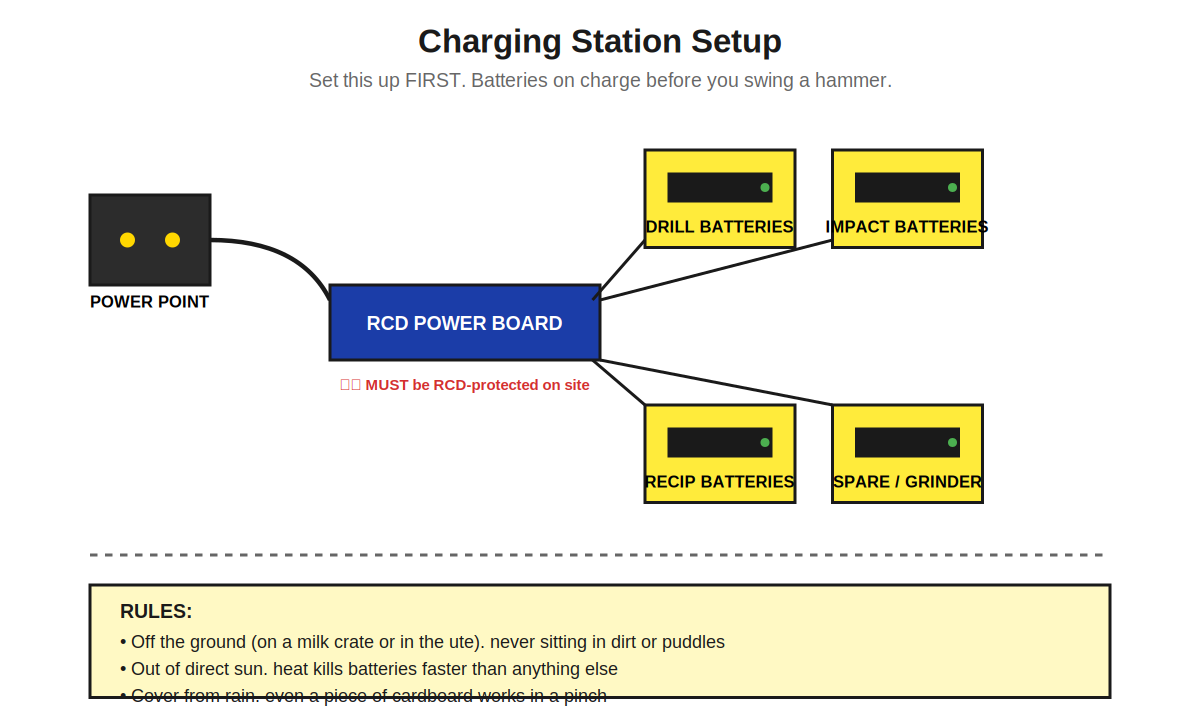
RCD power board. ALWAYS.
No exceptions. If there's no RCD board on the trailer, don't plug in. Ring me. RCD boards trip the power if something shorts out. Without one, you can electrocute yourself or burn the customer's house down. Not negotiable.
Set up the chargers.
Off the ground. Out of direct sun. Under cover. That's the principle. Whatever's around (off the ground, sheltered) does the job.
On charge from the start of the day:
- Drill batteries
- Impact batteries
- Recip batteries
- Grinder and spares
Number your batteries 1, 2, 3, 4 with a paint pen. Always grab the lowest number. They rotate evenly and last twice as long. A battery that gets hammered every day dies in 6 months. A battery in proper rotation lasts 3 years.
Fill the water bucket.
20L bucket from the customer's tap, or run a hose to where you're concreting. Either way, water needs to be within reach. Don't be walking 30m to the tap every post.
Running back to a tap costs 20 minutes a day. Multiply that by every job. That's hours we're burning over a week.
You go to plug the lead in and you can't find the RCD board. What's the right move?
- A) Plug straight into the customer's power point
- B) Use an extension cord without an RCD
- C) Don't plug in. Ring me.
- D) Borrow the customer's power board
Reveal answer ↓
Answer: C
No RCD board, no power. Full stop. Doesn't matter how urgent the job is. RCD protection is what stops a short circuit from killing you or burning the house down. If the board's missing, broken, or left at the depot, that's a STOP. Ring me. We'll sort it.
Why number the batteries 1, 2, 3, 4 with a paint pen?
- A) So we know whose battery is whose
- B) To rotate them evenly so they last twice as long
- C) To match them to specific tools
- D) Tradition
Reveal answer ↓
Answer: B
Always grab the lowest number. Charge it. Put it back in rotation. Batteries that get hammered every day die in 6 months. Batteries in proper rotation last 3 years. Same batteries. Same job. 6x the lifespan. That's hundreds of dollars saved per battery.
Think about the last time a battery died on site at the worst moment. Could it have been avoided with proper rotation or earlier charging? What changes tomorrow?
Lock In the Day
THE LESSON
Two minutes of planning saves two hours of stuffing around.
Once the Kickoff is done. Role 1 has the basics, Role 2 has the dilap, Role 3 has the chargers running, Role 4 has demo prep ready. The whole crew regroups at the start of the fence line. This is the two-minute day plan.
Walk the fence together.
Even though Role 2 already walked it for the dilap, the whole crew walks it now. Point at stuff. Talk about it.
Two blokes can stand at the same fence and see two different jobs. Get on the same page before tools come out.
Agree the order of work.
Standard 247 order, but the site can change it:
- Demo old fence into 800mm sections (Chapter 2)
- Stack the trailer (rails-interlocked. Chapter 2.)
- Dig end-post holes first. Set in concrete.
- Bottom string line up. Walk it. Find transitions and sleeper zones.
- Caterpillar set-out. Mark every post centre with spray.
- Bottom string OFF. Dig and concrete the middle post.
- Both strings back up between 3 posts. Eye-trick the sag out. Tie off at middle.
- Dig and set the rest of the intermediate posts.
- Sleepers in. Low side first.
- Rails (Colorbond LHS-only). Sheets with the hook trick. Eye it. Lock it off.
- Gates, capping, finish.
- Pack up. Crumb List. Walk the customer. Daily Drill. (Chapter 4)
Don't worry if you don't know every step yet. Chapter 3 covers install in detail. The point of this 2-minute plan is just to agree the order out loud so nobody's working at cross-purposes.
Find the tricky bits.
Look for stuff that's not standard:
- Transitions. Ground stepping up or down.
- Sleeper zones. Ground dropping away.
- Awkward access. Narrow side paths. Gates we have to lift over.
- Anything that wasn't visible in the quote photos.
Spotted something not in the quote? RING ME NOW. Not at 2pm when you've already started. NOW.
Ring me immediately if any of these:
- Retaining wall in the way and it's not in the quote, OR it's damaged
- Sleepers needed but not in our allowance for this job
- Extra height, different colour, extra bays customer asks for
- Tree or stump removal we didn't account for
- Damage to existing structures (their fence, their concrete, their tiles, anything)
- Boundary dispute with the neighbour
- Anything unexpected that adds time, material, or risk
Don't say yes to the customer. Don't say no. Don't try to be the hero. Ring me. I'll deal with it. We'll either do it as a variation, push it back to the office, or walk away. But that's MY call, not yours.
Lock in roles for the next phase.
Who's doing what from this point:
- Who's cutting demo with the recip
- Who's stacking the trailer
- Who's on post holes
- Who's running string lines and set-out
If we dig 19 holes and throw the dirt straight where the fence needs to go, we've just made ourselves another job. Think one step ahead. Always.
During the walk-together, you spot a retaining wall that wasn't in the quote. It needs to be removed before you can fence. What's the right move?
- A) Knock it down, we'll sort the paperwork later
- B) Skip it and try to fence around it
- C) Ring Tommy NOW, before any work starts
- D) Tell the customer it's their problem
Reveal answer ↓
Answer: C
Ring me NOW. Not at 2pm when you've already pulled half the old fence out. The earlier I know, the more options we have. Sometimes we can do it as a variation, sometimes the customer needs to organise it separately, sometimes we walk. But all those options disappear once you've started.
Why does the whole crew walk the fence together, even though Role 2 already did it during the dilap?
- A) To double-check the dilap photos
- B) Because the crew sees the job differently than one bloke does
- C) To stretch our legs
- D) It's not necessary. Role 2's walk is enough
Reveal answer ↓
Answer: B
Two blokes can stand at the same fence and see two different jobs. The walk-together is about getting everyone on the same page. Different eyes catch different problems. Five minutes of walking saves hours of fixing.
A proper 247 morning looks like this:
- 6:55am. Arrive 5 minutes early. Lunchbox out, chargers ready, tools sorted, coffee, eye the job notes.
- 7:00am. Door knock. Greet customer (both if you can). Kickoff splits into 4 roles.
- 7:00-7:15am. Front bloke chats with customer while others get into setup. All 4 roles in parallel.
- 7:15am. Regroup. Two-minute day plan.
- 7:17am. Tools go bang. Demo starts.
Other crews are still in the ute at 7:15. We're already cutting fence.
That's the 247 morning. Get it right and the whole day flows. Skip steps and you'll feel it at 3pm when you're scrambling.
Of the 6 lessons in this chapter (early arrival, parking, Kickoff, dilap, utilities, chargers, day plan). Which one do you reckon your crew currently does WORST? What changes tomorrow morning?
📝 Chapter Quiz
How early should you be on site, and what should you do with those minutes?
- A) Exactly on time, no earlier
- B) 5 minutes early. Get sorted in the ute (lunchbox, chargers, tools, coffee, job notes).
- C) 20 minutes early, walk around the customer's property to scope
- D) Whenever you can get there
Reveal answer ↓
Correct: B
5 minutes early is the target. Use those minutes for YOU. Get sorted in the ute. Don't walk around the customer's property uninvited. Knock at the agreed time.
The 247 Kickoff splits the crew into how many roles?
- A) Two
- B) Three
- C) Four
- D) Five
Reveal answer ↓
Correct: C
Four roles, four blokes, all at once. The Front, the Dilap, the Tools, and Demo Prep. Two-man crew? Same four jobs, one bloke doubles up.
The customer says they want an extra bay added that wasn't quoted. What do you do?
- A) Quote them and start
- B) Refuse outright
- C) Ring Tommy
- D) Tell them to call the office themselves
Reveal answer ↓
Correct: C
Variations get sorted by Tommy and the office. Don't say yes. Don't say no. Ring me. We work it out together. Scope, price, timeline.
What does the dilap process prove?
- A) That the crew showed up to site
- B) What the site looked like BEFORE we touched it
- C) That we did the job correctly
- D) Nothing. It's just for the office
Reveal answer ↓
Correct: B
Dilap is the photographic and written record of the site BEFORE we touched anything. It proves what was already cracked, broken, or knackered. Saves us from disputes weeks or months later.
Which photos should you take during dilap?
- A) Just obvious damage
- B) Only what the customer points out
- C) Heaps. Phones have unlimited photos
- D) A general overview shot is enough
Reveal answer ↓
Correct: C
Phones have unlimited photos. No cost to over-shooting. Big cost to under-shooting. Take wide shots AND close-ups of every issue.
What does DBYD stand for?
- A) Don't Break Your Drill
- B) Dial Before You Dig
- C) Dig Before You Decide
- D) Daily Before Your Day
Reveal answer ↓
Correct: B
Dial Before You Dig. Free Australian service. Ring 1100 or check byda.com.au. Office runs the search 5 working days before any dig job.
What's the colour code for marking water utilities?
- A) Red
- B) Orange
- C) Blue
- D) Green
Reveal answer ↓
Correct: C
Blue for water. Orange is power. Yellow is gas. Purple or white is comms. Green is sewer and stormwater. Same code every site, every state.
You're plugging the lead into the customer's power point and notice there's no RCD board on the trailer. What's the right move?
- A) Plug in anyway, it's only one day
- B) Borrow the customer's power board
- C) Don't plug in. Ring Tommy.
- D) Use a normal extension cord
Reveal answer ↓
Correct: C
No RCD board, no power. Full stop. RCD protection is what stops a short circuit from killing you or burning the house down. If it's missing, that's a STOP. Ring me.
Why number batteries 1, 2, 3, 4 with a paint pen?
- A) So we know whose battery is whose
- B) To rotate them evenly so they last 6x longer
- C) To match them to tools
- D) For warranty tracking
Reveal answer ↓
Correct: B
Always grab the lowest number. Rotate evenly. Batteries hammered every day die in 6 months. Batteries in rotation last 3 years. 6x lifespan. Hundreds of dollars saved per battery.
What's the purpose of the two-minute day plan after the Kickoff?
- A) To take a smoko break
- B) To get the whole crew on the same page about the order of work
- C) To wait for materials to arrive
- D) To re-photograph the fence
Reveal answer ↓
Correct: B
Two blokes can stand at the same fence and see two different jobs. The walk-together aligns everyone. Standard 247 order, but the site can change it. Roles locked in for the next phase. Two minutes here saves two hours later.
The morning is locked in. Now we cut the old fence down properly.
Read it. Use it. Get better.