PPE. Every Job. No Exceptions.
THE LESSON
Demo is the most dangerous part of the day. More blokes get hurt cutting fence down than putting it up.
It makes sense if you think about it. Demo means flying splinters, bent nails, screws sticking out at eye level, razor-edge Colorbond, and a recip saw that doesn't care what's in its way.
PPE on. Every job. No exceptions.
Eyes. Safety glasses. Not sunnies. Demo throws splinters, nails, screws. One bit of metal in an eye and you're off work for weeks. Maybe forever.
Ears. Recip's loud. So is the grinder. A long day without ear pro means you'll be deaf at 50. The damage doesn't show up today. It shows up in 20 years when your kids are saying "Dad" and you can't hear them.
Gloves. Heavy duty, cut-resistant. Bent nails. Razor-edge Colorbond. Splintered timber. Your hands are your tools. Look after them.
Boots. Steel cap. Always. Nails go through runners like butter. Through skin even easier.
If you don't have your PPE, the answer isn't "she'll be right for one job." The answer is stop and ring me. We'll sort it. Five minutes lost is better than a tetanus shot or a hospital visit.
You realise you've left your safety glasses at home. The boys are about to start demo. What do you do?
- A) Borrow someone else's
- B) Use sunnies, they're better than nothing
- C) Stop. Ring Tommy. Sort it before you start.
- D) Just be careful and crack on
Reveal answer ↓
Answer: C
No PPE, no demo. Doesn't matter how quick the job is. Five minutes lost is better than a metal splinter in your eye. Ring me, we'll figure it out. Pick some up from Bunnings, swap from another job, whatever. But don't start without it.
Why are steel-capped boots non-negotiable?
- A) They look professional
- B) Nails go through runners like butter
- C) Insurance requirement
- D) The boss said so
Reveal answer ↓
Answer: B
Demo means screws and nails on the ground everywhere. A running shoe gives you zero protection. A nail through the foot is a tetanus shot, an emergency room visit, and weeks off work. Steel caps cost $80. The hospital visit costs $5,000 plus lost wages.
Think about the last time you (or a teammate) cut a corner on PPE. What happened? What COULD have happened?
The Recip Cut (800mm Sections)
THE LESSON
The recip is your main tool for demo. Done right, it cuts a fence into perfect trailer-ready sections in minutes. Done wrong, it wrecks blades, damages posts, and slows the whole day down.
Pick the right blade.
Wood blade for timber. Metal blade for Colorbond. Wrong blade wrecks the blade and the cut.
Always have 2-3 spares of each in the demo apron. Blades die fast when they hit nails or screws. If you only have one and it dies mid-cut, you're walking back to the trailer, hunting through the tool box, and burning 5 minutes. Three spares in the apron means you grab and go.
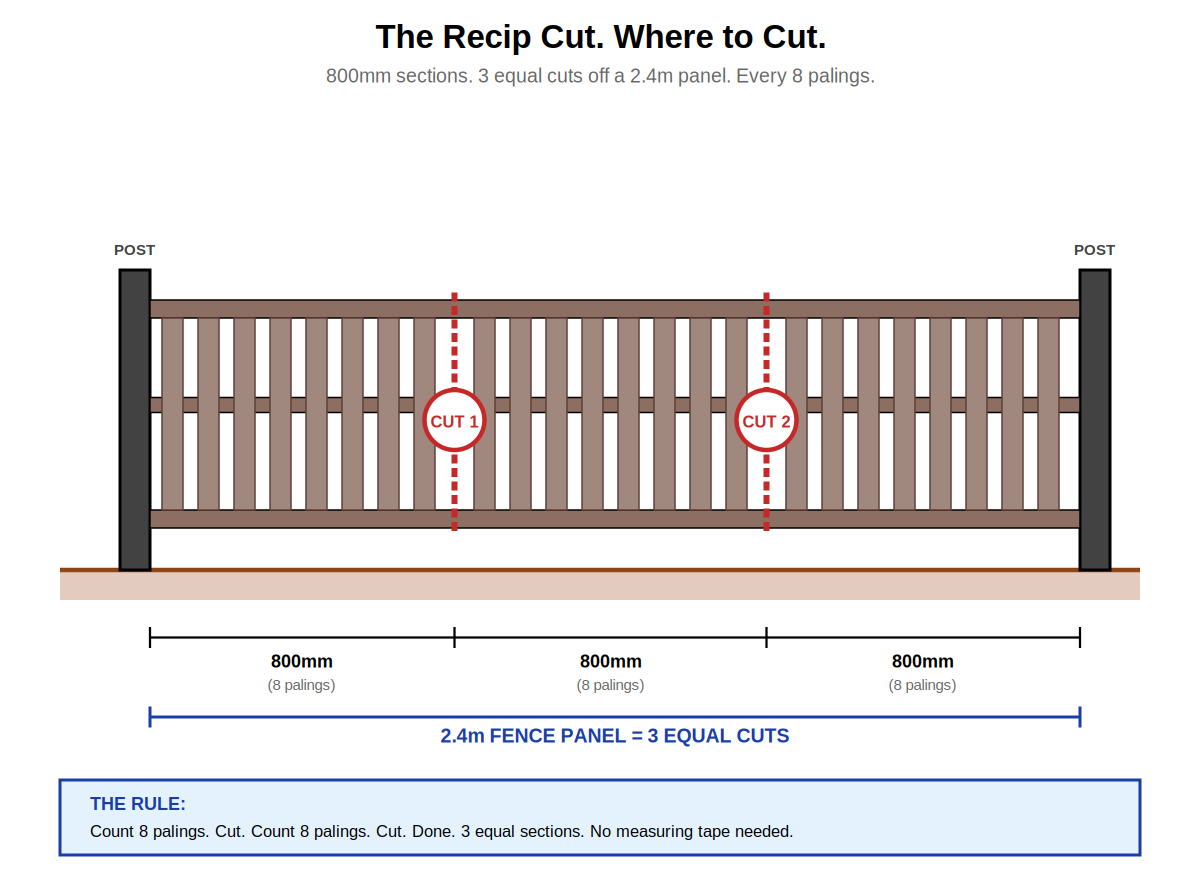
Count 8 palings. Cut.
Don't measure. Don't pull out a tape. Count 8 palings. Cut. Count 8 palings. Cut. Done. After a while it's just natural, you don't even count.
Why 800mm Demo Cuts
Video not playing? Watch it on Vimeo →
Watch Tommy explain why we cut at 8 palings. Three equal pieces. No waste. Two sections fit side-by-side in the trailer. The 800mm isn't random.
Here's the math behind it:
- 800mm equals 3 EQUAL cuts off a 2.4m panel. No waste.
- Two 800mm sections fit side-by-side in the trailer (1.8m wide).
That's why we count 8. Every panel becomes three perfect bits that stack perfectly. No measuring. No offcuts. No drama.
For Colorbond, demo it all in one go. No 800mm cuts. The sheets come off straight, fold and stack as you go.
Cut BETWEEN posts. Never INTO a post.
Posts stay in the ground until the demo is stacked.
Cutting into a post kills your blade AND damages the post hole. Costs you a blade and an hour. The recip blade is for the fence panels. The posts come out separately (Lesson 2.4). When you do cut posts 50mm below ground, careful of rocks and dirt. They'll wreck a blade faster than the post will.
Top down or bottom up. Your call.
Tall paling: cut the top off first so it falls away from you. Low Colorbond: cut the bottom rail first so you can drop the sheet flat.
Read the fence. Look at where the weight is. Cut so the bit you've just cut DOESN'T fall on you.
Stack as you go.
Soon as a section's free, it goes straight to the trailer. Stop. Stack. Continue.
Piles on the ground get tripped over, blow around, and slow you down at clean-up. The "I'll stack it later" approach loses you 15 minutes at the end of the day. Stack as you cut. The pile never builds up.
You're demoing a 2.4m timber paling panel. How do you decide where to cut it?
- A) Pull out a tape measure and mark 800mm increments
- B) Count 8 palings, cut. Count 8 palings, cut.
- C) Cut wherever looks even
- D) Cut it into 1m sections
Reveal answer ↓
Answer: B
Count 8 palings. Cut. No measuring. Standard paling spacing means 8 palings equals 800mm. Three equal cuts per panel. Zero waste. Zero offcuts. Two sections fit side-by-side in the trailer.
Your blade dies mid-cut. The next spare is in the trailer. What does this lesson tell you to do differently next time?
- A) Buy more expensive blades
- B) Keep 2-3 spares in the demo apron, not the trailer
- C) Cut slower so the blade lasts longer
- D) Don't worry about it. Spare blades are everywhere
Reveal answer ↓
Answer: B
Blades die fast. A 5-minute walk to the trailer per dead blade adds up to hours over a job. Spares in the demo apron means grab and go. Same blade. Different location. Saves the whole day.
The 800mm rule isn't a guess. It comes from two real-world constraints:
- A 2.4m panel divides into 3 equal 800mm pieces. No waste.
- A 1.8m wide trailer fits two 800mm pieces side by side with 200mm to spare.
Get one number right (800mm) and two problems solve themselves (no offcuts, perfect trailer fit). That's the 247 way. Find the number that solves multiple problems at once.
Most crews measure every cut. You're going to count 8 palings and cut. How much time per panel do you reckon this saves? Multiply by the number of panels in a typical job.
The Flip-and-Interlock Stack
The Flip-and-Interlock Trailer Stack
Video not playing? Watch it on Vimeo →
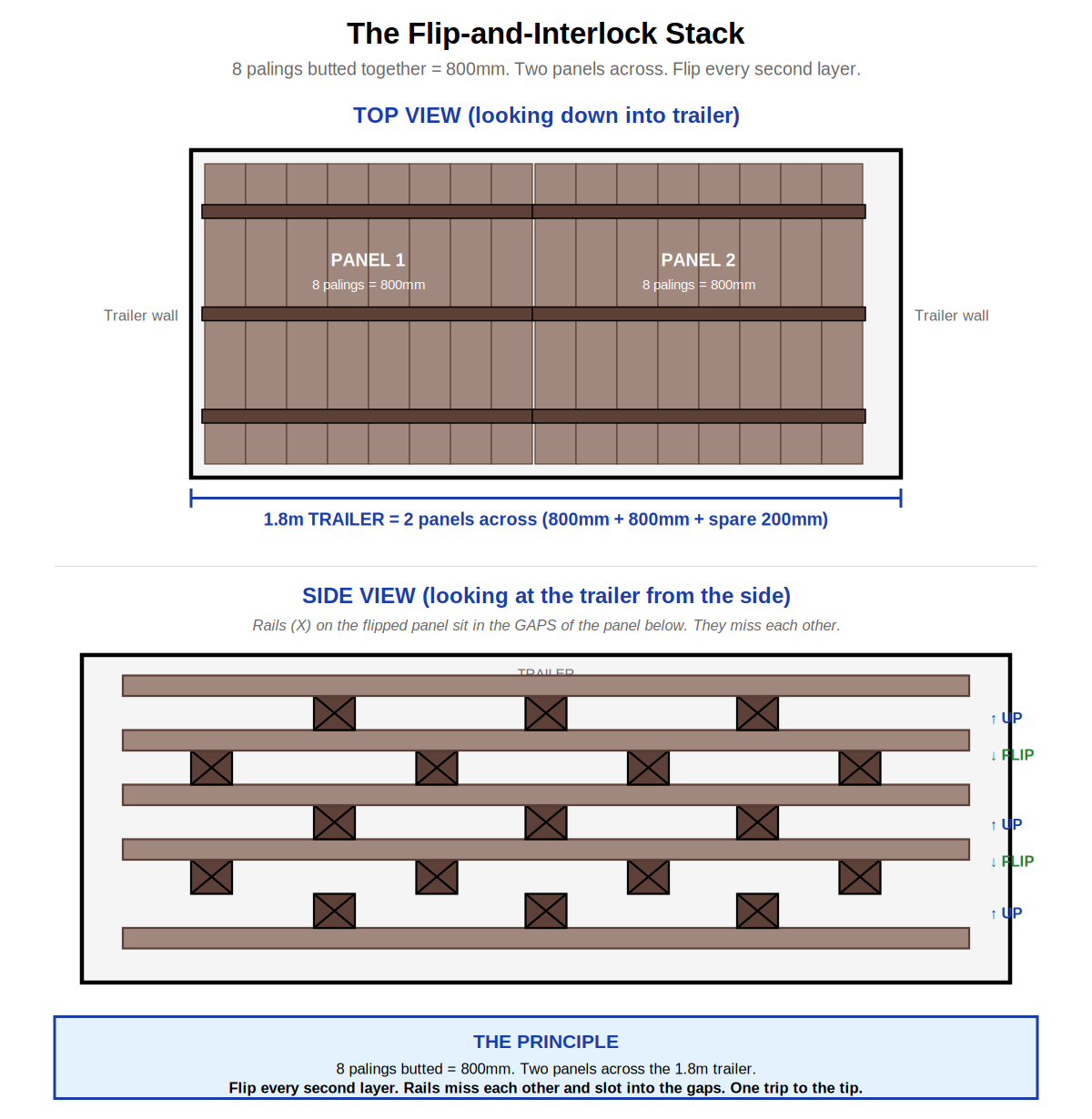
Layer 1 rails up. Layer 2 flipped, rails dropping into Layer 1's gaps. Doubles the trailer capacity. One tip trip not two.
THE LESSON
If you only learn one thing from this chapter, learn this. The Flip-and-Interlock Stack is the technique that doubles our load.
Most crews stack fence panels however they fall. Big mistake. By the third layer, the rails are clashing with each other and the stack wobbles. Trailer fills up at half capacity. They drive to the tip, dump, come back, stack the other half, drive to the tip again.
Two trips. Twice the diesel. Half the day wasted.
We do it different.
Layer 1. Two panels side-by-side. Rails UP.
First panel flat, rails facing the sky. Second panel right next to it. Two across the trailer width.
Why two? Trailer is 1.8m wide. Two 800mm sections fit with 200mm to spare. Don't waste that width.
Layer 2. Two panels FLIPPED. Rails DOWN.
Turn the next two over. Rails face the floor. Lay on top of Layer 1, side-by-side.
Here's the magic. The rails on the BOTTOM of Layer 2 drop INTO the GAPS between the palings of Layer 1. Stack sits flat. Tight. No wobble.
Layer 3. Back to rails UP.
Two panels side-by-side, rails to the sky. Just like Layer 1.
Keep alternating. Up. Down. Up. Down.
Every second layer flipped. Whole job in one trailer.
Stack from the FRONT of the trailer.
Heavy stuff over the axle. Light stuff at the back. Standard trailer balance.
Stack from the back forwards and you'll fishtail on the highway. Front-load it.
Strap before you drive. EVERY TIME.
Two ratchet straps minimum. One front, one back.
A loose load is a death sentence on the M1. Doesn't matter if it's only 5 minutes to the tip. Strap every time. Never strapped a load before? Ask someone. Don't guess.
You're starting Layer 2 of the stack. The rails on the panels should be facing which way?
- A) UP, same as Layer 1
- B) DOWN, so they drop into the gaps of Layer 1
- C) Sideways
- D) Doesn't matter
Reveal answer ↓
Answer: B
Down. The whole point of the flip-and-interlock is that Layer 2's rails drop into Layer 1's gaps. If you stack Layer 2 the same way as Layer 1, the rails clash, the stack wobbles, and you've wasted the technique.
Where on the trailer should the first panels go?
- A) At the very back
- B) Wherever there's space
- C) At the FRONT, over the axle
- D) Spread evenly
Reveal answer ↓
Answer: C
Heavy stuff over the axle. Stacking from the back forwards causes fishtail on the highway. The trailer swings side to side, especially at speed. Front-loading gives you a stable tow. Standard trailer physics.
It's a 5-minute drive to the tip. The load looks stable. How many ratchet straps do you use?
- A) None. It's only 5 minutes
- B) One should do it
- C) Two minimum. One front, one back. Every time.
- D) Depends on how tall the stack is
Reveal answer ↓
Answer: C
Two straps minimum. Every time. Doesn't matter if the trip is 5 minutes or 50. A loose load is a death sentence on the M1. The truck driver behind you doesn't care that "it looked stable when we left."
Done right, the Flip-and-Interlock Stack means we fit a full job's demo in one trailer load. One trip to the tip. One bit of diesel. One hour saved.
Across a year of jobs, that's hundreds of hours and thousands of dollars in fuel.
Same trailer. Same job. Half the trips.
Think about your last big demo job. How many trips to the tip did you do? With the Flip-and-Interlock Stack, could you have done it in fewer? Be honest about why.
Old Footings. Dig, Cut, or Leave.
THE LESSON
This is the call you've gotta make a hundred times a day on a strip-out. What do we do with the old post footings?
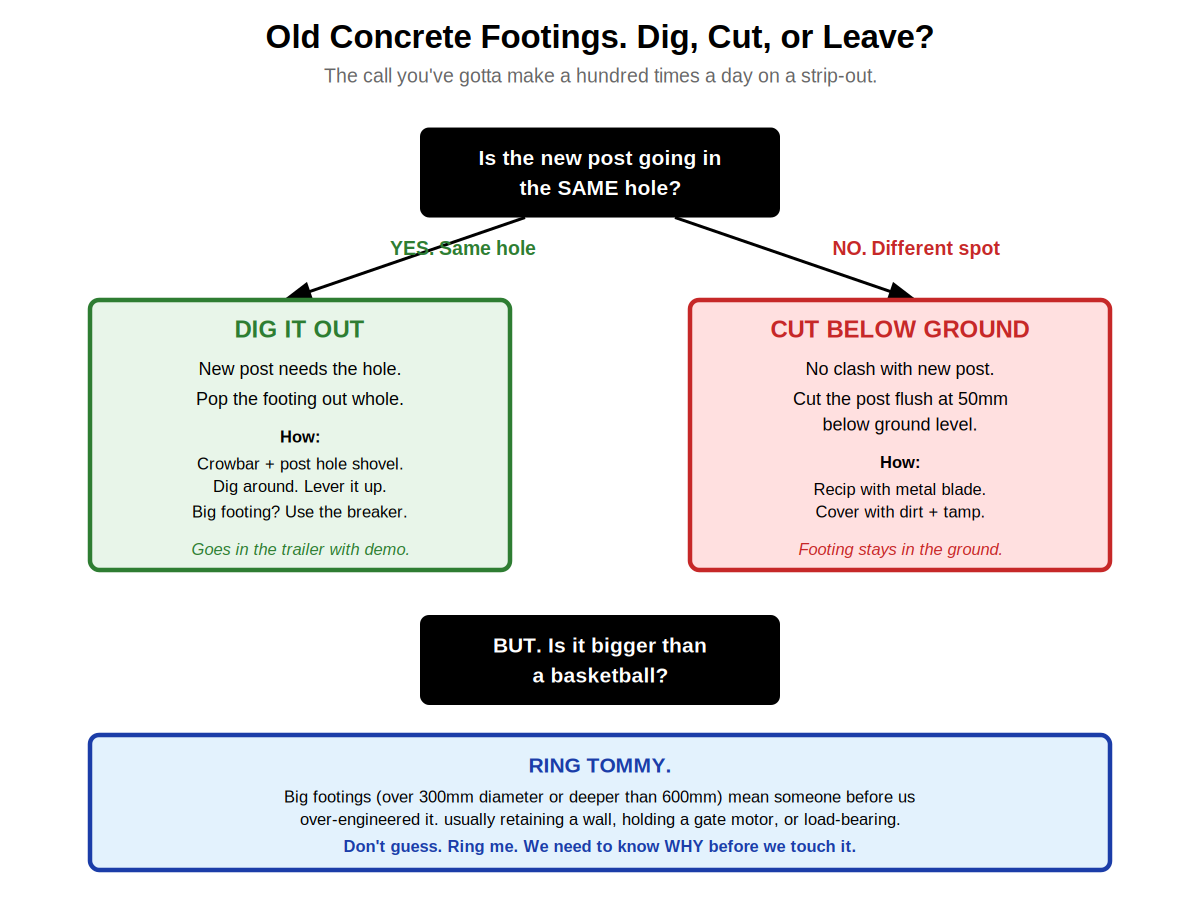
The answer depends on one question. Same hole, or different spot?
Same hole. Dig it out.
New post going back in the EXACT same hole as the old one? Old footing has to come out completely.
Crowbar plus a post hole shovel. Dig around it. Lever it up. Big footing? Breaker.
Tip: concrete comes out way easier when the ground's wet. Run the hose around it for 10 minutes. Saves your back. Five minutes of water versus 30 minutes of crowbar work. Pick water every time.
Different spot. Cut it below ground.
New post going in a different spot? Don't dig the old footing out. Cut it flush.
Timber or metal blade in the recip depending on what the post is. Cut flush 50mm below ground level. Cover with dirt. Tamp.
Customer can't see it. Saves an hour per post. The footing stays underground, undisturbed, doing nothing.
This is important for Chapter 3. In Chapter 3, we'll learn how to set out the new fence so we DODGE these old footings completely. Cutting them flush below ground means we don't disturb the ground around them. And the new post sits in clean soil a few hundred mm away.
Bigger than a basketball? STOP.
Footings over 300mm wide or 600mm deep mean someone over-engineered the old fence. Usually that means: retaining, gate motor, or load-bearing.
Don't guess. Ring me. We need to know WHY it was built that big before we touch it. Sometimes big footings are sitting on top of services. Sometimes they're holding up a retaining wall. Sometimes they're fine to remove. We work it out together.
The new fence is going in a different spot to the old fence. You find an old post footing. What's the right move?
- A) Dig it out completely so the ground is clean
- B) Cut it flush 50mm below ground level and cover with dirt
- C) Leave it sticking up. Tommy will sort it later
- D) Try to dig around it without disturbing it
Reveal answer ↓
Answer: B
Different spot means we don't need that hole. Cut the footing flush 50mm below ground and bury it. Customer never sees it. We save an hour per post. The old footing stays in the ground doing nothing. And in Chapter 3 we'll learn how to dodge it during set-out.
You find a footing that's about the size of a small esky. Way bigger than a basketball. What does this tell you?
- A) The old fencer was over-prepared
- B) Someone built it big for a reason. Could be retaining, gate motor, or load-bearing
- C) It's normal for old fences
- D) It needs to be removed straight away
Reveal answer ↓
Answer: B
Big footings have a reason. Could be a gate motor anchored to it. Could be retaining behind it. Could be hiding services. Stop. Ring me. We work out what it is BEFORE we touch it. Never guess on something that big.
Have you ever fought with an old footing that took way longer than expected? With hindsight, was it a "dig out" situation or a "cut below ground" situation?
Disposal. The Cost Trap.
THE LESSON
This is where most crews bleed money without knowing it.
Different rubbish has different rates at the tip. Mix them up and you pay the highest rate for everything in the load. Most crews don't think about this. They throw everything in one trailer and pay the maximum rate. We don't.
Know what each tonne costs us.
Worth memorising:
- Demo rubbish (timber, mixed): $350 per tonne
- Concrete (kept separate): $40 per tonne
- Green waste: $80 per tonne
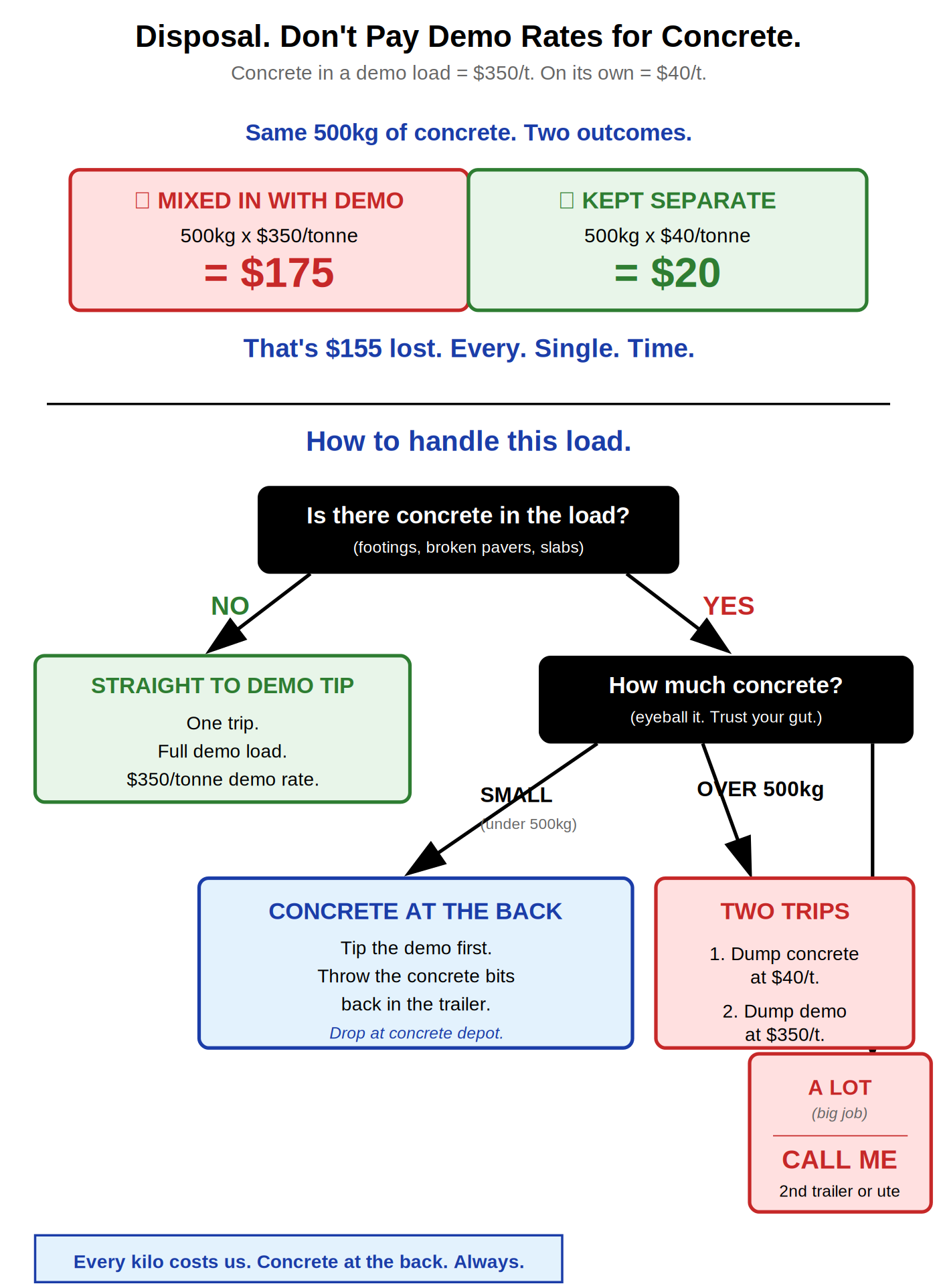
Concrete on its own is dirt cheap. Mix it into demo and it's now $350 per tonne. Nine times more for the same bit of concrete. That's the trap.
The straight-up cost of mixing concrete with demo.
Real numbers:
- 500kg of concrete on its own = $20
- 500kg mixed in with demo = $175
- That's $155 we just gave to the tip for nothing
- 3 jobs a week, that's $465
- Across a year, over $24,000 we lit on fire
Twenty-four grand. Every year. For nothing. Just by mixing concrete in with demo. Be smart about what goes where.
Concrete at the BACK of the trailer. Always.
One piece or a heap. Concrete goes at the back so we can deal with it separately.
Small concrete (under 500kg).
Tip the demo first. Throw the concrete bits back in the trailer. Drop at the concrete depot on the way home. Two stops. One run.
Keeping concrete out of the demo load also keeps the trailer lighter for the trip home. Easier on the ute.
Over 500kg of concrete. Two trips.
First trip: dump concrete only ($40 per tonne). Second trip: dump demo ($350 per tonne).
Mixed in costs $350. Separate costs $40 plus a bit of extra time. Time is cheaper than the saving. Two trips is the smart move.
Massive concrete? Ring me.
Big slab demos or commercial jobs might need a separate ute, a hire trailer, or a skip on site. Don't try to fit a tonne of concrete into our trailer. Ring me, we'll sort the right setup.
Green waste. Don't pay if we don't have to.
Default 247 move: neat pile at the customer's house. They put it in their green bin over a few weeks.
- Big load? Neat pile at customer's. Theirs to bin.
- Small amount? Chuck in their green bin as a favour.
- Customer doesn't want it? Council tip at $80/tonne. ONLY if it was quoted.
Customer wants us to take ALL the green waste away and it's not in the quote? Don't agree. Ring me.
Colorbond and steel. Beer money.
Scrap metal yard. Pays US instead of charging us.
Keep a separate stack for clean steel. Old gates, frames, rails. Drop at the scrap yard before the tip run. Free beer money for the crew.
Photo the weighbridge ticket.
Into ServiceM8. Every trip.
Some customers ask for proof of disposal. Some councils audit. Photo once, save forever.
You've got 500kg of concrete to dispose of, mixed in with the demo load. What does this cost vs. dumping the concrete separately?
- A) About the same either way
- B) $20 separate vs. $40 mixed. Small difference
- C) $20 separate vs. $175 mixed. That's $155 wasted
- D) Concrete is free at the tip
Reveal answer ↓
Answer: C
500kg concrete separate = $20 (at $40/t rate). 500kg mixed into demo = $175 (because it's now charged at $350/t demo rate). That's $155 we just gave the tip for nothing. 3 jobs a week, $465. Across a year, over $24,000 burnt.
Where on the trailer should concrete pieces go?
- A) Mixed throughout, doesn't matter
- B) At the front over the axle
- C) At the BACK so we can deal with it separately
- D) On top of the demo
Reveal answer ↓
Answer: C
Concrete at the BACK. Always. Easy to grab and drop at the concrete depot before we tip the demo. Mixed in means it gets charged at $350/t. Separate means $40/t. The back of the trailer is the line between cheap and expensive.
The customer wants us to take ALL their green waste away, but it wasn't in the quote. What's the right move?
- A) Take it as a favour, it's only green waste
- B) Refuse, that's not our problem
- C) Ring Tommy before agreeing to anything
- D) Charge them on the spot for the extra
Reveal answer ↓
Answer: C
Variations get sorted by Tommy and the office. Don't say yes (we'd lose money on $80/t green waste we didn't price for). Don't say no (we might lose the customer over something small). Ring me. We work out what's fair.
Every kilo in the trailer is a kilo we pay to dump. The smarter we are about what goes where, the more profit stays in the business.
Three principles:
- Don't mix concrete with demo. Costs 9x more per kilo
- Don't pay for green waste if the customer can handle it
- Scrap metal pays US. Keep it separate
Done right, demo disposal goes from a cost to a profit centre.
Calculate roughly how much concrete you've dumped in the last month. How much of that was probably mixed with demo? What's that cost the business?
📝 Chapter Quiz
You've forgotten your safety glasses. The crew is about to start demo. What do you do?
- A) Borrow someone else's
- B) Use sunnies
- C) Stop. Ring Tommy. Sort it before starting.
- D) Be careful and crack on
Reveal answer ↓
Correct: C
No PPE, no demo. Doesn't matter how quick the job is. Five minutes lost is better than metal in an eye.
How do you decide where to cut a 2.4m timber paling panel?
- A) Pull out a tape measure
- B) Count 8 palings, cut. Count 8 palings, cut.
- C) Cut by eye
- D) Cut into 1m sections
Reveal answer ↓
Correct: B
Count 8 palings. Equals 800mm. Three equal cuts per panel. No waste. Two pieces fit side-by-side in the trailer.
Should you cut into a post with the recip?
- A) Yes, it's faster
- B) Only if the post is rotten
- C) Never. Cut between posts only.
- D) Sometimes, depends on the post
Reveal answer ↓
Correct: C
Never cut into a post. Wrecks the blade AND damages the post hole. Posts stay in the ground until demo is stacked. Then they come out separately.
On the Flip-and-Interlock Stack, what direction do the rails face on Layer 2?
- A) UP, same as Layer 1
- B) DOWN, dropping into Layer 1's gaps
- C) Sideways
- D) Doesn't matter
Reveal answer ↓
Correct: B
Layer 2 flipped. Rails DOWN. They drop into Layer 1's gaps. Stack sits flat and tight. Without the flip, the rails clash and the stack wobbles.
How many ratchet straps do you use, minimum?
- A) None for short trips
- B) One
- C) Two. One front, one back, every time
- D) Depends on the load
Reveal answer ↓
Correct: C
Two straps minimum. Every time. Even a 5-minute trip can kill someone. A loose load on the M1 is a death sentence.
New fence is going in a different spot than the old fence. You find an old post footing. What do you do?
- A) Dig it out completely
- B) Cut it flush 50mm below ground, cover with dirt
- C) Leave it sticking up
- D) Try to dig around it
Reveal answer ↓
Correct: B
Different spot means we don't need that hole. Cut flush, bury it. Customer never sees it. Saves an hour per post. Chapter 3 covers how we dodge it during set-out.
You find a footing the size of a small esky. What's the right move?
- A) Dig it out. It's just bigger
- B) Cut it flush like any other
- C) Stop. Ring Tommy. Big footings have a reason.
- D) Leave it for the next crew
Reveal answer ↓
Correct: C
Big footings mean retaining, gate motor, or load-bearing. Could be hiding services. Stop. Ring me. We work it out before touching it.
What's the cost difference between dumping 500kg of concrete separately vs. mixed with demo?
- A) About the same
- B) $5 difference
- C) $20 vs. $175. That's $155 wasted
- D) Concrete is free
Reveal answer ↓
Correct: C
Separate concrete is $40/t. Mixed-in concrete gets charged at demo rate of $350/t. 500kg separate = $20. 500kg mixed = $175. Across a year of jobs, this mistake burns $24,000.
Where should concrete pieces go in the trailer?
- A) At the front over the axle
- B) Mixed throughout
- C) At the BACK, separate from demo
- D) On top of the demo
Reveal answer ↓
Correct: C
Concrete at the BACK. Always. Easy to grab and drop at the concrete depot before tipping demo. Back of the trailer is the line between $40/t and $350/t.
The customer wants us to take ALL their green waste away, but it wasn't in the quote. What do you do?
- A) Take it as a favour
- B) Refuse outright
- C) Ring Tommy before agreeing
- D) Charge them on the spot
Reveal answer ↓
Correct: C
Variations go through Tommy and the office. Don't say yes (we lose money on un-quoted disposal). Don't say no (we might lose the customer). Ring me. We sort it together.
Demo done right. Now we put a fence up properly.
Read it. Use it. Get better.