Site Clean
THE LESSON
The last hour matters most.
A great install ruined by a sloppy pack-up equals a customer who remembers the mess, not the fence. A solid job closed properly equals a customer who tells three friends. Same fence. Different outcome.
Site clean is the physical work. Most of the Crumb List items we'll meet in Lesson 4.3 are about this step. Doing it once well beats doing it twice.
Pick up every screw, nail, and offcut.
Walk the line slowly. Eyes on the ground. Nothing left behind that a kid or dog could find.
A single screw left in the lawn can puncture a tyre, hurt a pet, or get caught in a mower. One missed screw can cost us the next job AND a callback.
Sweep all paths, driveways, and pavers.
Broom out the dust and debris. Don't just push it onto the lawn. That's where it'll wash back the first time it rains.
Hose the driveway if dusty.
Light hose-down. Don't flood the place. Just enough to clear the concrete dust.
Customer notices the driveway more than the fence on the way home. Clean driveway = first impression of a finished job.
All rubbish out. Materials cleaned and stacked.
Old fence pieces, offcuts, packaging, takeaway cups. Nothing of OURS stays on the property.
Plants tidy. Dirt back.
Anything we trampled or moved gets put back as best we can. Fluff up flattened plants. Backfill any dirt we dug up.
This is where the customer's wife or husband (whoever's NOT been here all week) walks out and judges us. They didn't see the work. They only see what we left behind.
You've finished sweeping the driveway and the leftover dust is on the lawn. Is that good enough?
- A) Yes. Better than nothing
- B) No. Push it back onto the driveway and bag it
- C) No. Rain will wash it back. Bag the dust or use the dustpan.
- D) Yes. The lawn hides it anyway
Reveal answer ↓
Answer: C
Pushed onto the lawn, the dust washes back onto the driveway the first time it rains. Customer sees streaks. Looks lazy. Bag it properly or scoop it up.
Why is "plants tidy, dirt back" on the site clean list?
- A) It's a council requirement
- B) The customer's partner who DIDN'T see the work judges us on what we left behind
- C) Just to be polite
- D) It's not really important
Reveal answer ↓
Answer: B
The partner walks out at the end of the day, doesn't know what the job involved, and forms an opinion in 30 seconds based on what they see. Trampled plants and dirt piles = sloppy job. Tidy plants and backfilled ground = finished job. Same fence either way.
Of all the site clean items (screws picked up, paths swept, driveway hosed, rubbish out, plants tidy). Which one does your crew typically skip or rush? What happens because of it?
Walk Your Own Work First
THE LESSON
Before the Crumb List. Before the customer. Before anyone else sees it. YOU eye it.
This is the cheapest insurance in fencing. Five minutes of walking your own work catches things that would otherwise become callbacks.
Stand at the LEFT end. Eye the fence.
Look down the line. Sheets flush? Gate hanging right? Anything that looks off?
Walk to the RIGHT end. Eye it back.
Different angle. Different light. Catches what one walk misses.
The light hits the fence differently from each direction. A bowed rail you didn't see from the left might be obvious from the right.
Find anything you wouldn't want the customer to find.
A bowed rail. A missed screw. A scuff on a sheet. A gap that shouldn't be there.
If YOU find it first, you can fix it in 5 minutes with no drama. If the CUSTOMER finds it, it becomes a callback, a complaint, and a story they tell.
Same problem. Two completely different costs.
Fix it now. Even if it's small.
Touch-up paint. Tighten a screw. Re-seat a sheet. Take the 5 minutes.
Boys get tempted to leave small things and 'come back later'. Don't. You won't come back. And if you do, it's expensive. You'll spend more on diesel and time than fixing it now ever would have cost.
You spot a sheet that's slightly drifted out of plumb during your own walk. Customer hasn't noticed. What do you do?
- A) Leave it, the customer won't notice
- B) Fix it now while it's a 5-minute job
- C) Mention it to the customer
- D) Note it for next time you're in the area
Reveal answer ↓
Answer: B
Fix it now. Five minutes of work. If you leave it, it becomes a callback when the customer eventually spots it. And callbacks cost a full day (drive, fix, drive back) and damage trust. Better to spend 5 minutes now than a full day later.
Why walk the fence twice. From BOTH ends?
- A) To get exercise
- B) The light hits the fence differently from each direction. Catches different problems
- C) Tradition
- D) The first walk is for the customer, the second is for us
Reveal answer ↓
Answer: B
Eyeing twice from both ends catches what one walk misses. A bowed rail you didn't see from the left might be obvious from the right. Different angle. Different light. Different problems caught.
The boys often get tempted to leave small fixes "for next time". But next time rarely comes. Why does the 5-minute fix NOW always win?
The Crumb List
THE LESSON
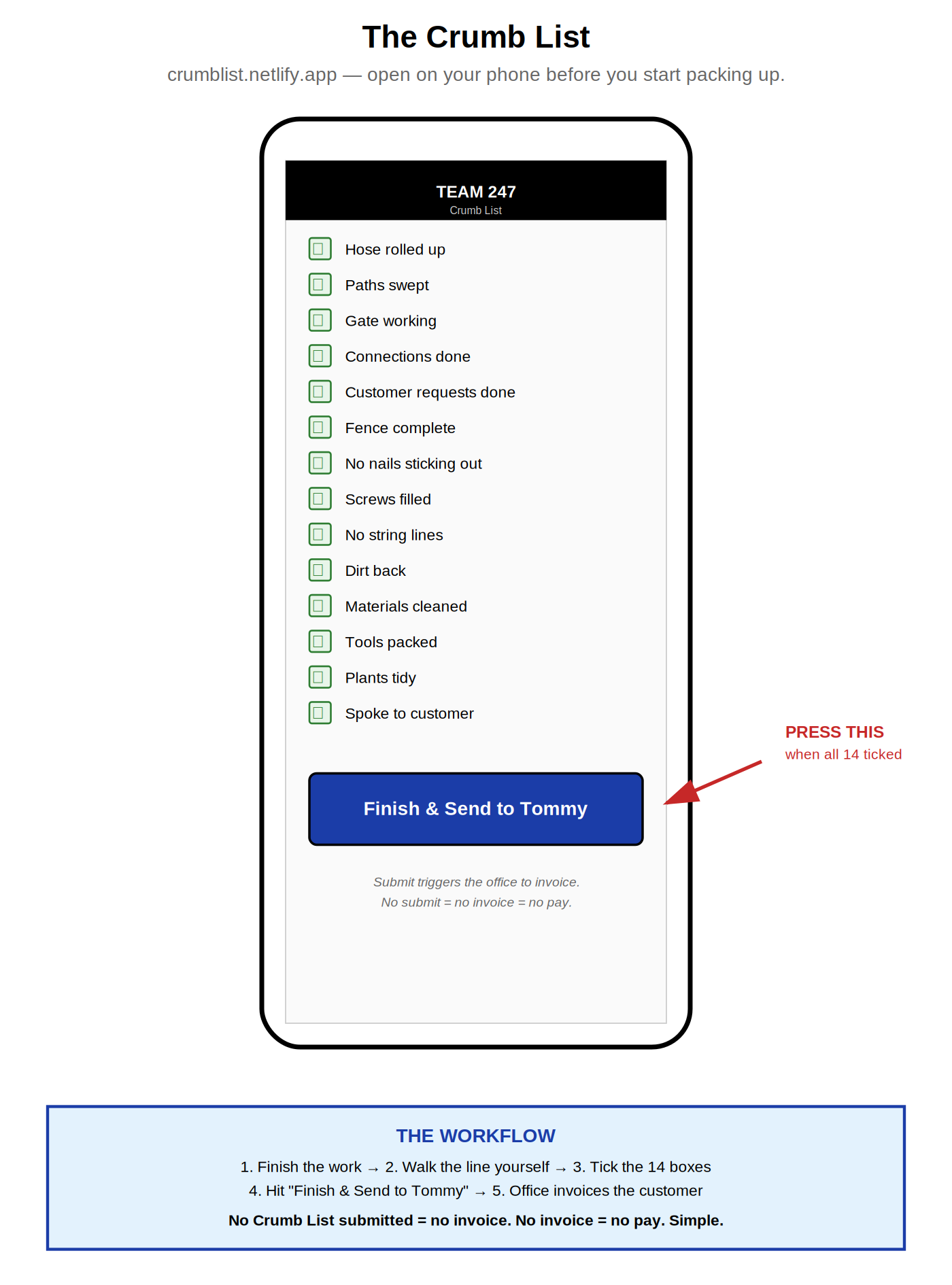
The Crumb List is our official pack-up checklist. 14 items. Open it on your phone. Tick them off. Submit to Tommy.
It lives at crumblist.netlify.app. Bookmark it on your phone.
This is the formal check that triggers the office to invoice the customer. No Crumb List submitted = no invoice = no pay. Simple.
Open the Crumb List on your phone.
crumblist.netlify.app. Bookmark it. It opens on any phone, no login needed.
Walk the property. Tick each item only when DONE.
Don't tick from the ute. Don't tick if it's mostly done. Each tick = that thing is actually finished.
The 14 items:
- Hose rolled up
- Paths swept
- Gate working
- Connections done
- Customer requests done
- Fence complete
- No nails sticking out
- Screws filled
- No string lines
- Dirt back
- Materials cleaned
- Tools packed
- Plants tidy
- Spoke to customer
Each item links back to work we did during the day. "No string lines" means we've taken down the strings we put up in Chapter 3. "Connections done" means anything we needed to connect (gate hardware, sleepers, capping) is finished. "Spoke to customer" means we've at least confirmed they know we're done.
All 14 ticked. Hit 'Finish & Send to Tommy.'
This is the submit button. Press it. Tommy gets the notification. Office starts the invoice.
If something on the list genuinely can't be done today (waiting on a part, customer not home, weather issue). Don't lie and tick it. Note it in ServiceM8 and ring Tommy. We deal with it together. Faking ticks gets the office to invoice for something that isn't actually done. And that's a way bigger problem than a delayed invoice.
You've finished the job. The Crumb List has 13 items ticked. Item 14 (Spoke to customer) is tricky because the customer isn't home. What's the right move?
- A) Tick it anyway. You tried to call
- B) Don't submit. Wait until the customer is home and you've actually spoken.
- C) Tick it and add a note in ServiceM8 saying they weren't home
- D) Tick it but ring Tommy to explain
Reveal answer ↓
Answer: B (best) or D (acceptable)
The 14 items mean those things are DONE. "Spoke to customer" means actually spoke. If they're not home, don't fake a tick. That lets the office invoice when the customer hasn't been engaged with. Either wait until they're home, or ring Tommy and discuss the right next step.
What happens after you press "Finish & Send to Tommy"?
- A) Nothing. It's just for the boys
- B) Tommy gets a notification and the office starts the invoice
- C) The customer gets a copy
- D) It uploads to ServiceM8 automatically
Reveal answer ↓
Answer: B
The Crumb List submit IS the trigger for invoicing. The office can't bill the customer until they know the job is done. And the submitted Crumb List is how they know. Press the button = office invoices. Don't press = no invoice = no pay to you.
This isn't a guilt trip. It's how the system works.
The office invoices on the back of two things: photos in ServiceM8 (Lesson 4.4) and a submitted Crumb List. Both. Every job.
No submit = no invoice. No invoice = no pay. Late submit = late pay.
Press the button. Every job. Every time.
Of the 14 Crumb List items, which 1-2 are easiest to skip or fudge on a busy day? Why is that risky?
Photos into ServiceM8
THE LESSON
Visual proof attached to the job. Same SOP as the dilap photos in Chapter 1. Different end of the day.
Dilap photos from the morning prove what was there BEFORE. Finish photos from now prove what we left.
Together, they protect us, win disputes, and trigger the invoice along with the Crumb List.
Full coverage. Walk the whole fence.
Take a photo every 3-4 metres along the run. Both sides. Like the dilap pattern.
If a customer ever rings about damage we 'caused', the dilap photos prove what was there BEFORE we started. If a customer ever rings about install quality, the finish photos prove what we left.
Photos protect us. Photos win disputes. Photos get us paid faster.
Key feature shots. The detail.
Specific shots that show workmanship:
- Gate detail. Hinges, latch, drop bolt.
- Sleeper line. Full length, both ends.
- Capping. Post caps, top capping.
- Any feature the customer asked for specifically.
These shots prove the quality of the finish work. If a customer rings about the gate latch in 6 months, we've got a photo of it working properly on the day we left.
Upload to ServiceM8. Tag the job.
All photos attached to the job before you leave the site. Not 'when I get home'. Not 'in the morning'. NOW.
ServiceM8 uploads over mobile data. Don't wait for wifi. Once a photo's on the phone and not in ServiceM8, it's already 50% likely to never get uploaded.
How often should you take photos along the fence run during the finish-photo walk?
- A) One photo at each end
- B) Every 3-4 metres, both sides
- C) Just the gate and one wide shot
- D) Whenever there's something interesting
Reveal answer ↓
Answer: B
Every 3-4 metres, both sides. Same pattern as the dilap. Comprehensive coverage means if a customer ever rings about ANY section of the fence, we've got a photo of that exact section as we left it.
You've taken all the photos. The wifi is patchy on site. What's the right move?
- A) Wait until you get home and upload over wifi
- B) Upload NOW over mobile data
- C) Email them to yourself
- D) Save them and upload tomorrow
Reveal answer ↓
Answer: B
Upload now over mobile data. Once a photo's on the phone and not in ServiceM8, it's 50% likely to never get uploaded. Boys forget. Phones die. SD cards corrupt. The data cost is nothing compared to the cost of missing photos when a dispute comes up.
Have you ever needed photos for a dispute and not had them? What changes about how seriously you take the finish photos after that?
Customer Walk + Don't Over-Justify
The Customer Walk: Don't Over-Justify
Video not playing? Watch it on Vimeo →
Watch Tommy do the final walk. All done. Fence is in. Gate swings sweet. Stay carefree. Job went to plan. We're happy.
THE LESSON
Read the customer. Not every job needs a walk. The ones that DO need it, need it done right.
Is the customer around? Are they engaged?
If they're hovering, watching, asking questions. Walk them.
If they're inside, busy, or already paid no attention all week. Just leave it clean and head off. Forcing a walk on a disengaged customer feels weird and might come across like we're fishing for praise.
Skipping a walk for a customer who's been involved feels like we don't care. Read the room.
If you're walking them: start at one end. Finish at the gate.
Gate is the most visible piece. End on the strongest piece of work. Customer leaves the walk impressed.
Point out the work. Don't over-explain.
Show the gate. Show the line. Show what you're proud of. SHORT sentences. Confident tone.
Here's the BIG cultural lesson.
THE WRONG WAY: OVER-JUSTIFYING
This is what most fencers do. They explain every problem they had during the job. They want the customer to know how hard it was. They're fishing for sympathy and credit.
Sounds like this:
"Yeah look, we had a real shocker with the soil, it was rock at 500mm so we had to break through with the breaker, took us ages."
"That gate was a nightmare, the posts shifted in the concrete and we had to redo the hinges twice. Hopefully it should be fine now."
"The last sheet didn't quite line up but we made it work. You might notice it's a bit tight on one side."
What the customer hears:
- Something went wrong with my job
- The gate might fail
- The last sheet is a defect
- They cut corners somewhere
- I should inspect everything
- I might need to call them back
Trust drops. Callbacks rise. Customer points out things they wouldn't have noticed. We invited the problem.
THE 247 WAY: STAY CAREFREE
Carefree. Job went to plan. We're happy.
Sounds like this:
"All done. Fence is in. Gate swings sweet. Want me to walk you along the line?"
"This is the gate. Drop bolt here, latch there. Tested it. Closes nice and easy."
"All cleaned up. We're happy with it. Any questions just give the office a ring."
What the customer hears:
- The job went to plan
- These guys know what they're doing
- The fence is solid
- I got my money's worth
- I'd hire them again
- I might recommend them
Trust grows. Callbacks rare. Customer happy. Office invoiced. Job remembered well. That's how we get referrals.
Same fence. Same work. What we SAY decides what they REMEMBER.
Any questions go to the OFFICE.
Don't promise warranty work. Don't quote variations. Don't agree to come back and check it.
Customer questions = "great question, give the office a ring, they'll sort you out."
The boys on site shouldn't be the ones managing customer expectations or making commitments. That's Tommy and Sarah's job. Stay in your lane.
Customer asks how the job went. Your honest answer is "actually pretty tough, rock at 500mm slowed us down heaps." What do you SAY to the customer?
- A) "Actually it was pretty tough, rock at 500mm slowed us down heaps."
- B) "All done. Fence is in. Gate swings sweet."
- C) "Took longer than expected because of the soil."
- D) "Yeah it was hard but we got through it."
Reveal answer ↓
Answer: B
Don't over-justify. The customer doesn't know what was supposed to be hard or easy. If you tell them "it was tough", they hear "something went wrong" and start inspecting. Stay carefree. Job went to plan. We're happy.
Customer says "I noticed the gate sticks a bit when I open it. Can you come back and adjust it?" What do you say?
- A) "Yeah no worries, I'll come back tomorrow"
- B) "Great question. Give the office a ring and they'll sort it out"
- C) "It's not really sticking, it's fine"
- D) "I'll do it now but only if you pay me cash"
Reveal answer ↓
Answer: B
Don't agree to come back. Don't promise work. Don't quote on the spot. Stay in your lane. Send the question to the office where Tommy and Sarah can handle it properly. Schedule a callback if needed, decide if it's warranty, etc.
The diagram you saw shows it clearly. Two crews. Identical work. Identical fence. Identical materials.
Crew 1 explains every problem → customer remembers a difficult job → low trust → callbacks → no referrals.
Crew 2 stays carefree → customer remembers a smooth job → high trust → no callbacks → referrals.
What we SAY at handover is worth more than what we BUILT during the install. Both matter. But the conversation costs nothing and pays massive dividends.
Be honest. Do you tend toward over-justifying with customers? Why? What's the change for tomorrow?
Load Up + Daily Drill
THE LESSON
Closing the day properly. Tools away. Last lap. Then 5 minutes at the tailgate before you drive off.
Tools in the ute. Each one in its place.
Don't just chuck them in. They live in specific spots so the morning is faster tomorrow. The ute setup is your dawn assistant. Done right, you can find any tool in 5 seconds without thinking.
Last lap of the property.
One final walk before the ute leaves. Anything we missed? Tool left behind? Bit of rubbish on the lawn?
The last thing the customer sees is what stays in their memory. A clean property = a finished job in their mind. A tool left behind = a story they tell about 'those guys who left a hammer in my garden.'
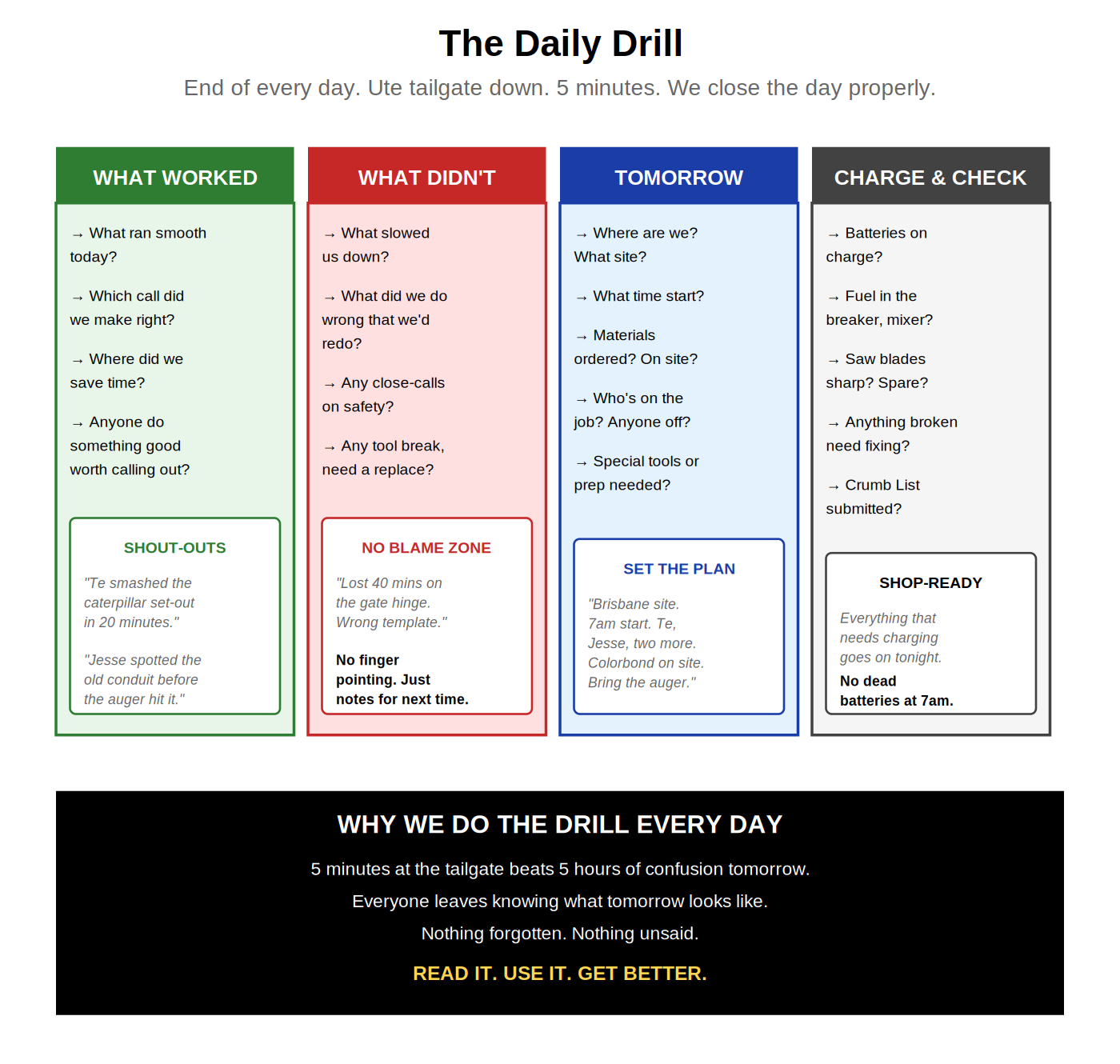
Tailgate down. Daily Drill. 5 minutes.
The whole crew. End of every day. Even if we're knackered. Even if it's late.
You met the Daily Drill back in Chapter 0. Now it's time to actually run it on a job site. Four parts. Five minutes. Tailgate down.
Part 1. WHAT WORKED.
Each bloke says ONE thing that went well today. A trick that saved time. A call that worked. A teammate who smashed it.
This isn't fluff. It's how we lock in the good calls. If we don't name what worked, we lose it.
Part 2. WHAT DIDN'T.
Each bloke says ONE thing that didn't work. NO BLAME. We're noting it, not pointing fingers.
If we hide what didn't work, we'll do it again tomorrow. Saying it out loud means the whole team learns from one bloke's mistake. Cheap lesson for everyone.
Part 3. TOMORROW.
Where are we? What time start? Who's on the crew? What materials? Anyone need to bring something special?
Flag any material shortfalls NOW. Ran out of rapid set on the last bay? Tell the office tonight. Sleepers we'll need but didn't have? Tell them tonight. Tomorrow at 6:30am Bunnings is closed, and at 7am Ourtown is busy. The office can pre-order overnight and have it ready for pickup before the day starts.
Lock in one change for tomorrow. Not ten. One.
Part 4. CHARGE & CHECK.
Batteries on the charger tonight. Fuel topped up. Anything broken called out so it can be replaced before 7am tomorrow.
Dead batteries at 7am cost us 20 minutes of the morning. 5 minutes tonight saves that. Always.
It's 5:30pm. The crew is knackered. Do you still do the Daily Drill?
- A) No. We'll do it tomorrow morning instead
- B) Yes. Every day, no exceptions, even when knackered
- C) Only if there was a problem worth discussing
- D) Only on Fridays
Reveal answer ↓
Answer: B
Every day. No exceptions. The day you skip is the day you lose the learning. 5 minutes at the tailgate beats 5 hours of confusion tomorrow. Knackered = the cheap version of the drill. Bare bones, but still done.
During "What didn't" the team identifies that we lost 40 minutes because the wrong gate hinges were on the trailer. Whose fault is it?
- A) Whoever loaded the trailer
- B) Whoever quoted the job
- C) NO BLAME ZONE. Blame the system, not the bloke
- D) Nobody
Reveal answer ↓
Answer: C
No blame zone. The question isn't "who stuffed up". It's "how did the system let this happen, and what do we change so it doesn't happen again?" Finger-pointing kills improvement and shuts the rest of the team up.
Why charge batteries the NIGHT BEFORE during Charge & Check?
- A) Tradition
- B) Dead batteries at 7am cost us 20 minutes of the morning. 5 minutes tonight saves that.
- C) Batteries last longer if charged at night
- D) The customer might use our charger
Reveal answer ↓
Answer: B
Dead batteries at 7am cost 20 minutes scrambling. 5 minutes tonight on the charger saves that 20 minutes tomorrow. Net win: 15 minutes. Across a year, that's hours of productive morning time.
5 minutes at the tailgate beats 5 hours of confusion tomorrow.
Everyone leaves knowing what tomorrow looks like. Nothing forgotten. Nothing unsaid.
This is the same Daily Drill you read about in Chapter 0: but now you're DOING it, every day, at the tailgate. That's the difference between knowing about something and using it.
Read it. Use it. Get better.
Pick ONE change you're going to make tomorrow based on this whole Day Guide. Just one. Write it down. Tomorrow you'll either have done it or not.
📝 Chapter Quiz
Why does the last hour of the day matter so much?
- A) It doesn't really
- B) A clean pack-up shapes what the customer remembers. Same fence, different memory
- C) Tommy says so
- D) Because of overtime pay
Reveal answer ↓
Correct: B
A great install with a sloppy pack-up = customer remembers the mess. Solid job closed properly = customer tells three friends. Same fence. Different memory.
Why walk the fence yourself BEFORE the Crumb List and BEFORE the customer?
- A) To stretch your legs
- B) To find problems before they become callbacks. Fix it now, cheap
- C) To check the customer is happy
- D) Just tradition
Reveal answer ↓
Correct: B
If YOU find it, 5 minutes to fix. If the CUSTOMER finds it, it's a callback, complaint, and a story they tell. Same problem. Two completely different costs.
The Crumb List has how many items?
- A) 10
- B) 12
- C) 14
- D) 16
Reveal answer ↓
Correct: C
14 items at crumblist.netlify.app. Plus the "Finish & Send to Tommy" submit button.
The Crumb List submit triggers what?
- A) Nothing. It's just for the boys
- B) Tommy gets notified and the office starts the invoice
- C) The customer gets a copy automatically
- D) A pay run
Reveal answer ↓
Correct: B
Submit triggers the office to invoice. No submit = no invoice = no pay. Press the button. Every job. Every time.
The wifi is patchy on site. You've taken the finish photos. What do you do?
- A) Wait until you get home
- B) Upload now over mobile data
- C) Email them to yourself
- D) Save them and do it tomorrow
Reveal answer ↓
Correct: B
Upload now. A photo on the phone and not in ServiceM8 is 50% likely to never get there. Boys forget. Phones die. The data cost is nothing compared to missing photos during a dispute.
Customer asks how the job went. Your honest answer is "actually pretty tough." What do you SAY?
- A) "Actually it was pretty tough."
- B) "All done. Fence is in. Gate swings sweet."
- C) "Took longer than expected."
- D) "Yeah it was hard but we got through."
Reveal answer ↓
Correct: B
Don't over-justify. Customer doesn't know what was supposed to be hard. "It was tough" = they hear "something went wrong" and start inspecting. Stay carefree. Job went to plan.
Customer says "the gate sticks a bit. Can you come back?" Right response?
- A) "Yeah no worries, I'll come back tomorrow"
- B) "Great question. Give the office a ring and they'll sort it"
- C) "It's not really sticking"
- D) "I'll fix it now but only if you pay cash"
Reveal answer ↓
Correct: B
Stay in your lane. Send the question to the office. Tommy and Sarah handle scheduling, warranty, and customer expectations. The boys on site don't make those commitments.
It's 5:30pm. The crew is knackered. Do you still do the Daily Drill?
- A) No, do it tomorrow morning
- B) Yes. Every day, no exceptions
- C) Only if there was a problem
- D) Only on Fridays
Reveal answer ↓
Correct: B
Every day. The day you skip is the day you lose the learning. 5 minutes at the tailgate beats 5 hours of confusion tomorrow. Knackered version is bare bones but still done.
During "What didn't". The wrong gate hinges were on the trailer. Whose fault?
- A) Whoever loaded
- B) Whoever quoted
- C) NO BLAME. Blame the system, not the bloke
- D) Nobody
Reveal answer ↓
Correct: C
No blame zone. Question is "how did the system let this happen, and what do we change?" Finger-pointing kills improvement.
Why charge batteries the NIGHT BEFORE?
- A) Tradition
- B) 5 minutes tonight saves 20 minutes of morning scrambling
- C) Batteries last longer charged at night
- D) Customer's power costs more during the day
Reveal answer ↓
Correct: B
Dead batteries at 7am cost 20 minutes of morning. 5 minutes tonight saves that. Across a year, hours of productive morning time saved.
You've finished the Day Guide. One more quiz to earn the badge: the Certification Quiz. 20 questions across all 5 chapters. 80% to pass. Unlimited retakes.
You've worked through 32 lessons and 5 chapter quizzes. You know the 247 way. Now you go do it. Every day.
Read it. Use it. Get better.
Tommy Jackson
Director, Team 247